Calculate the real SaaS savings of a tool bundle in 2026
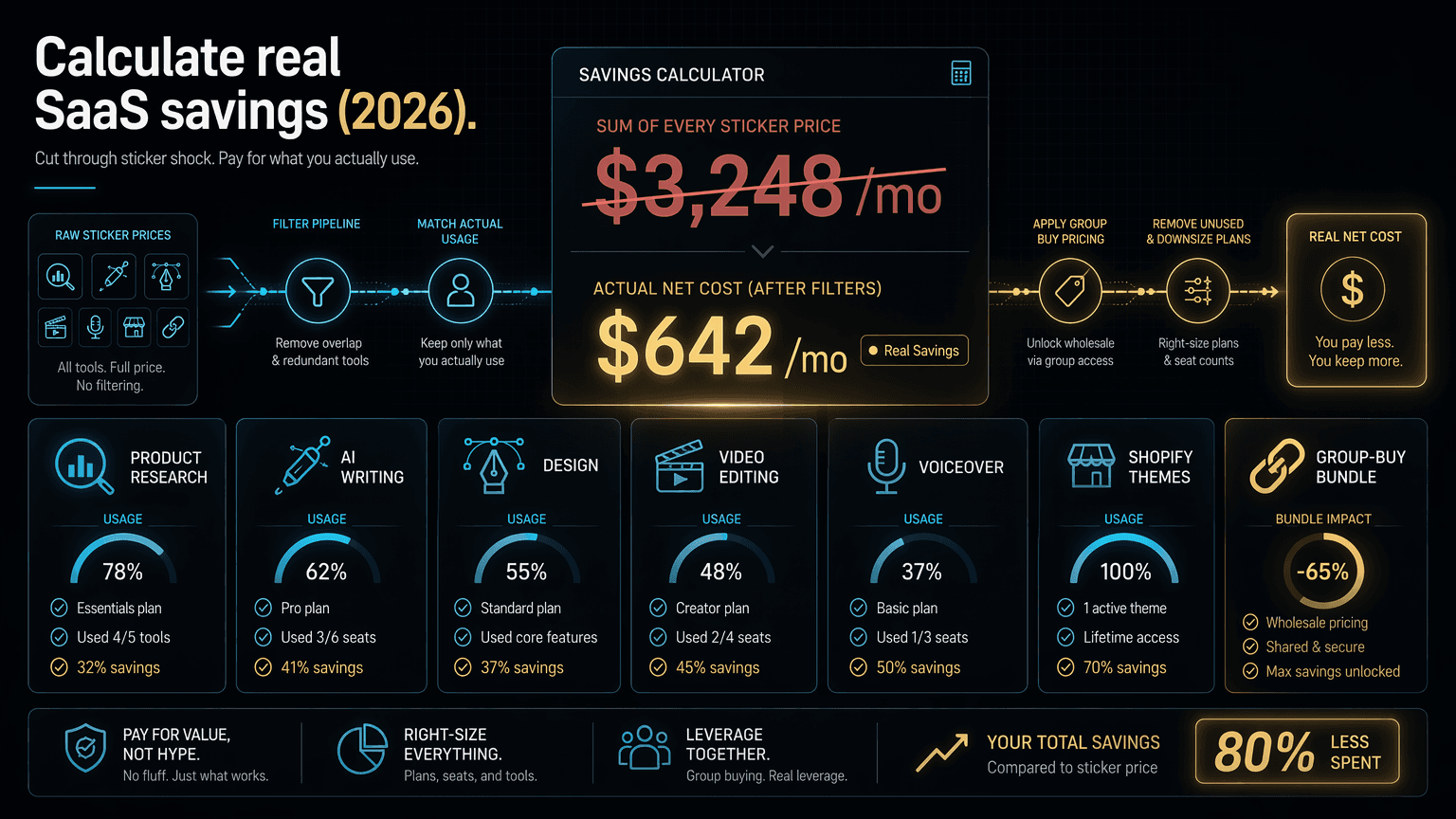
The sticker total is not your savings. Use the keep-skip method to find the real SaaS savings of a tool bundle: only the tools you would buy, minus $29.99.
Your savings is not the sticker total of every tool in the bundle. It is what you would have actually paid, at the tier you would actually use, minus the price of the bundle. Nothing else counts.
By Maxime Yao, research editor | Published 2026-07-17
Here is the scene every bundle landing page wants you to live in. A table lists eight tools. Next to each, a price. At the bottom, a big number, say two hundred and forty dollars a month, glowing like a jackpot. Then the flourish: our price is $29.99. You save over two hundred dollars a month. You feel the dopamine hit. You reach for your card.
Stop. That number is fiction. Not a lie about the prices, the prices might be real, but a lie about the word savings. You were never going to buy all eight tools. You would have bought two, maybe three. The rest are strangers you have never paid for and never would. Counting them as savings is like a gym telling you that you saved a thousand dollars because you did not hire a personal trainer you never wanted. The math adds up. The meaning is garbage.
This guide fixes that. It gives you a method to calculate what a group-buy tool bundle actually saves you, in your currency, with your usage, using real researched prices. Then it shows you exactly when the bundle wins and when it quietly loses. No cheerleading. Just the arithmetic that survives contact with your real workflow.
TL;DR
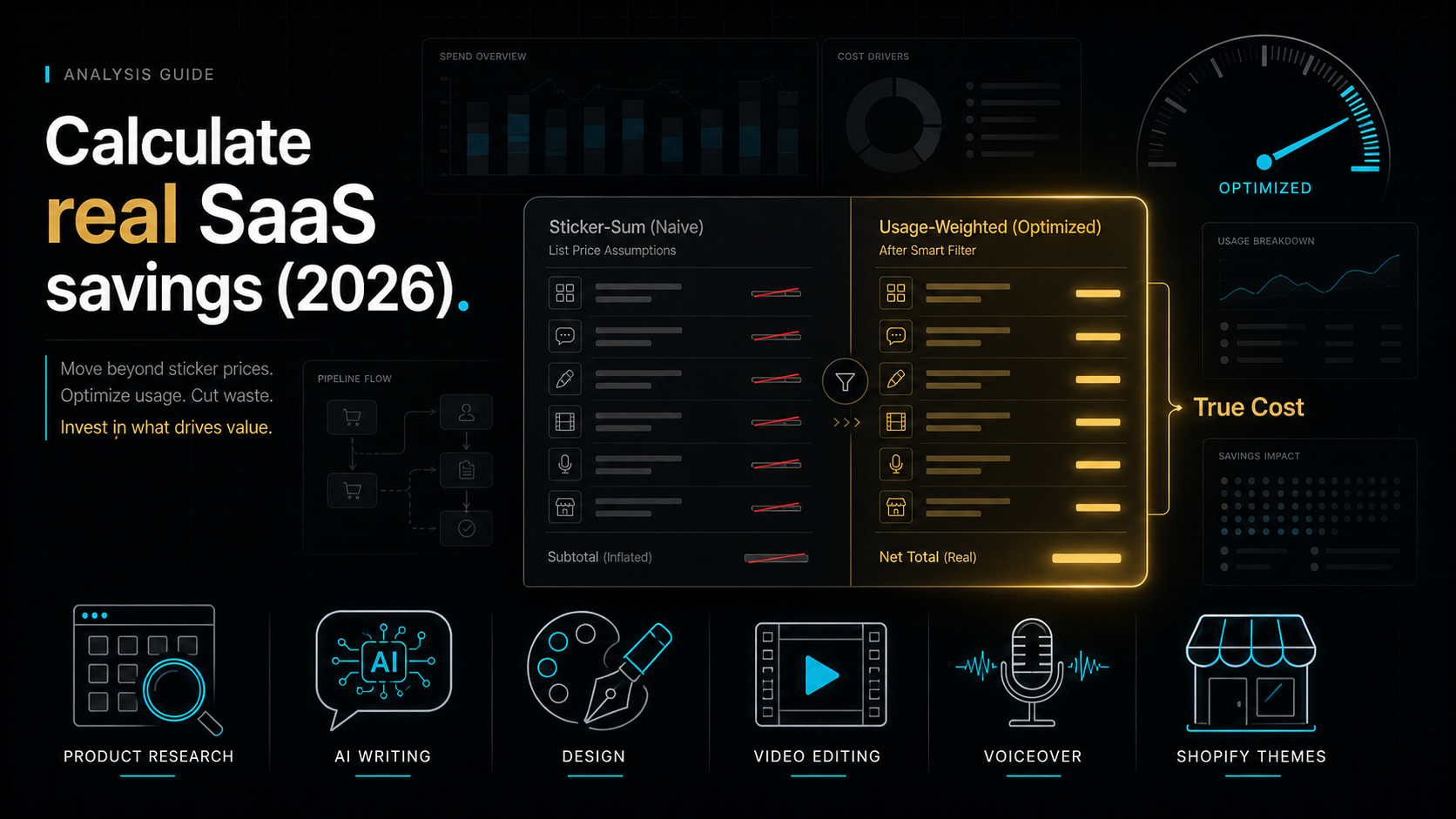
- The lie that costs you money: add up every sticker price and that is your savings. It is not. It is a made-up number that counts tools you would never buy.
- The fix: the keep-skip filter. Only count tools you would genuinely pay for, at the tier you would actually use. Add those, then subtract the bundle price.
- The one number that matters: your honest net saving. Keep-list total minus $29.99. In the worked example below it is about $119 a month, not the $211 the sticker sum would claim.
- Ecom Tools is a group-buy bundle. One Whop subscription grants shared, Discord-delivered access to paid tools. That model is why the price is low, and it carries real caveats you must weigh.
- When the bundle wins: your honest keep-list clears $29.99 with room to spare. When it loses: you would only ever pay for one or two of the tools, and the bundle costs more than they do.
What savings actually means, before you count a cent
Savings is a comparison between two futures. Future A: you buy the tools you need, one by one, at retail. Future B: you buy the bundle. Savings is A minus B. That is the entire concept.
The trap is in Future A. The honest version of Future A is the tools you would really have bought. The dishonest version, the one the landing page uses, is every tool in the catalogue, whether you wanted it or not. Swap the honest Future A for the dishonest one and your savings number inflates by hundreds of dollars without a single real thing changing in your life.
So the whole game is defining Future A correctly. Get that right and the savings number becomes trustworthy. Get it wrong and you have talked yourself into a purchase with a number you invented. For the head-to-head version of this comparison, we go deep in Ecom Tools vs buying the tools separately. This guide is the calculator underneath that decision.
The costly belief: the sticker sum is your savings
Let us state the lie plainly so we can kill it: add up every sticker price and that is your savings.
It is seductive because the arithmetic is real. The prices might be accurate. The subtraction is correct. What is broken is the premise underneath: that you would have bought all of it. You would not. Nobody does. A TikTok Shop seller does not need a Shopify competitor spy. A copywriter does not need a TikTok analytics suite. A beginner with one product does not need an ad-spy tool billing fifty dollars a month for data they cannot yet act on.
Here is the inflated pitch, built from real researched retail prices. These figures are illustrative, based on published retail pricing for each tool; verify current pricing, because these vendors change plans often. They are not Ecom Tools numbers. They show what the underlying tools list for if you subscribed to each yourself.
| Tool in the catalogue | Illustrative published price |
|---|---|
| PipiAds (Basic) | about $49/month |
| ShopHunter (entry plan) | about $50/month |
| KaloData (Starter) | about $40 to $46/month |
| Canva Pro | about $15/month |
| ChatGPT Plus | about $20/month |
| Claude Pro | about $20/month |
| CapCut Pro | about $20/month |
| ElevenLabs (Creator) | about $22/month |
Illustrative, based on published retail prices; verify current pricing. Add those eight and you clear two hundred and forty dollars a month before you even count the 140-plus Shopify themes. The landing-page move is to slap $29.99 under that total and announce a two-hundred-dollar saving. It is the most persuasive number on the page. It is also the least true, because it assumes a version of you that buys everything.
The villain here is not the tool. It is the sticker-sum math itself, the same move used by every cable bundle, every insurance upsell, every value-meal that counts items you would have skipped. It works because subtraction feels like proof. It is not proof. It is a magic trick performed with prices.
The fix: the keep-skip filter
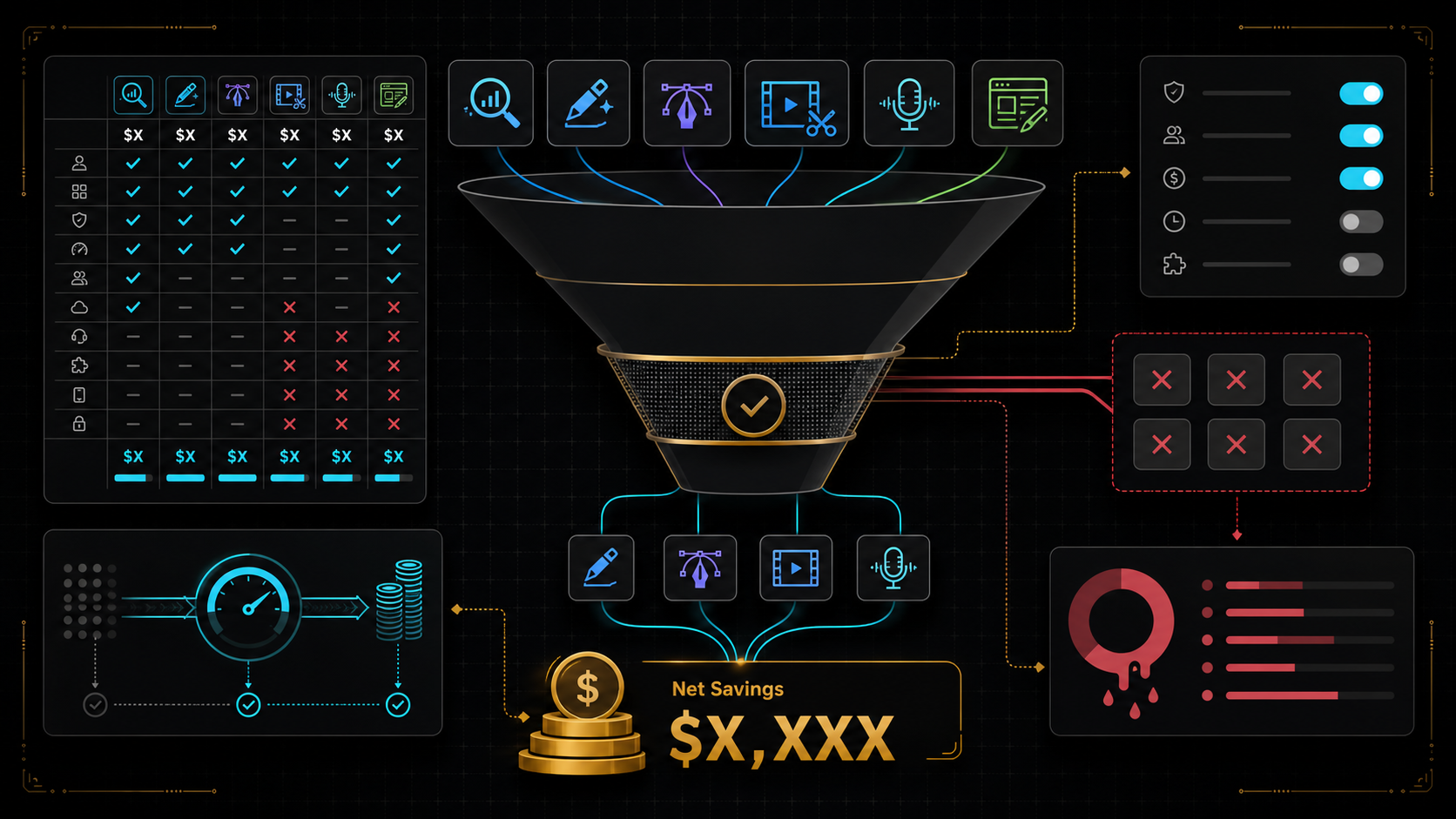
The fix is a filter, and it takes about five minutes. Call it the keep-skip filter. Run every tool in the catalogue through two questions:
- Would I actually pay for this, Not would I use it if it were free. Would I put my own card down for it this month to do my real work. If no, it is a skip, and it contributes zero to your savings.
- At which tier, If yes, which plan would you honestly buy. The cheapest one that does your job, usually, not the top tier the sticker-sum quietly assumes. Price your keep at that tier.
Everything that survives both questions goes on your keep list. Everything else is a skip and gets a hard zero. Then you do one subtraction:
Honest net saving = (sum of your keep list at the tier you would use) minus $29.99.
That is the whole mechanism. It is not clever. Its power is that it refuses to count a single tool you would not have bought. The sticker sum inflates by counting strangers. The keep-skip filter deflates back to the truth by throwing every stranger out. The number it produces is the only savings figure you should ever put your money behind.
The worked calculator, start to finish
Let us run it on a real profile. Say you are a TikTok Shop dropshipper. You research winning products, cut short-form video, write hooks, and design creatives. You do not run a Shopify storefront and you do not do AI voiceovers. Watch what the filter does.
| Tool | Illustrative price | Keep or skip | Why | Counts toward saving |
|---|---|---|---|---|
| PipiAds (Basic) | about $49/mo | Keep | Core TikTok ad research | $49 |
| KaloData (Starter) | about $45/mo | Keep | TikTok Shop analytics you use weekly | $45 |
| Canva Pro | about $15/mo | Keep | Every creative and thumbnail | $15 |
| CapCut Pro | about $20/mo | Keep | Daily video editing | $20 |
| ChatGPT Plus | about $20/mo | Keep | Hooks, scripts, product copy | $20 |
| ShopHunter | about $50/mo | Skip | Shopify spy, you sell on TikTok | $0 |
| Claude Pro | about $20/mo | Skip | ChatGPT already covers your writing | $0 |
| ElevenLabs (Creator) | about $22/mo | Skip | No AI voiceover in your workflow | $0 |
| 140-plus Shopify themes | varies | Skip | Not on Shopify | $0 |
Now add the keep list only: $49 plus $45 plus $15 plus $20 plus $20 equals $149 a month. That is your honest Future A. It is the real money you would have handed to five separate vendors to do your real work.
Subtract the bundle:
$149 minus $29.99 equals about $119 a month. That is your honest net saving.
One hundred and nineteen dollars a month is a strong number. It is real. You would defend it in front of an accountant. Now compare it to the sticker-sum pitch. The full catalogue of paid tools summed to about $241, so the landing page would claim $241 minus $29.99, roughly $211 a month saved. The gap between the pitch and the truth is about ninety-two dollars a month, and it is made entirely of three tools you would never have bought: ShopHunter, Claude Pro, and ElevenLabs. Fifty plus twenty plus twenty-two. Ninety-two dollars of imaginary savings, evaporated the moment you applied the filter.
That ninety-two dollars is the whole scam in one figure. Not a lie about prices. A lie about you.
The trap: saving on tools you would never buy
Here is the trap dressed up as a bonus, because it is the sneakiest part. When a bundle includes a tool you would never pay for, the landing page counts its full price as savings. But a tool you would not buy has a real-world value to you of zero. Counting its price as savings does not just overstate the number. It inverts the logic.
Think it through. If ElevenLabs is worth zero to you because you never make voiceovers, then including it saves you nothing, because you were spending nothing on it. The sticker sum treats a twenty-two-dollar tool you would never touch exactly the same as a twenty-two-dollar tool you use daily. To the honest calculator, they are opposites. One is worth twenty-two dollars of avoided spend. The other is worth nothing, and pretending otherwise is how you talk yourself into a purchase you should have questioned.
There is a second-order version too. A bundle full of tools you do not need is not a better deal. It is a worse fit. Nine tools where you use three means six tools of clutter, six sets of shared credentials, six things that can break or get swapped, for zero benefit to you. Breadth you cannot use is not value. It is noise the sticker sum prices as if it were signal.
The discipline is brutal and simple: a tool you would not buy contributes nothing to your savings. Zero. Not its sticker price. Not half its sticker price. Zero. The moment you let a single unwanted tool onto the keep list, you are back to inventing numbers.
When the bundle does not win
The keep-skip filter is honest in both directions. It will tell you to buy, and it will tell you to walk. Here is the walk-away case, because a calculator that only ever says yes is a sales tool, not a calculator.
Take a true beginner. One product idea, no ad budget yet, no Shopify store, no video pipeline. Run the filter honestly and the keep list is short:
| Tool | Illustrative price | Keep or skip | Counts |
|---|---|---|---|
| Canva Pro | about $15/mo | Keep | $15 |
| ChatGPT Plus | about $20/mo | Maybe | $20 or $0 |
| Everything else | various | Skip | $0 |
If this beginner would genuinely pay for both Canva Pro and ChatGPT Plus, the keep list is $35, and the honest net saving is $35 minus $29.99, about five dollars a month. Technically positive. Practically thin. Five dollars of monthly saving is not a reason to take on shared-account complexity you do not need yet.
Now the harder truth. If that beginner would honestly only pay for Canva Pro, one tool at fifteen dollars, then the keep list is $15, and the math flips: $15 minus $29.99 is negative fifteen dollars a month. The bundle costs more than the only tool you actually wanted. You would be paying $29.99 to access fifteen dollars of value. The sticker sum would still scream two hundred dollars of savings. The honest calculator says you are losing money. Trust the honest one.
This is the rule the sticker sum can never give you: the bundle only wins when your honest keep list clears $29.99 with margin. If your keep list is one or two cheap tools, buy those tools directly and skip the bundle. No amount of catalogue breadth changes that, because breadth you will not use is worth nothing.
Win or lose, at a glance
| Your honest keep list | Keep total | Net vs $29.99 | Verdict |
|---|---|---|---|
| Five tools you use weekly | about $149/mo | about +$119/mo | Bundle wins clearly |
| Three solid tools | about $84/mo | about +$54/mo | Bundle wins |
| Two tools, one pricey | about $64/mo | about +$34/mo | Bundle wins, comfortably |
| Two cheap tools | about $35/mo | about +$5/mo | Too thin, buy direct |
| One tool | about $15/mo | about minus $15/mo | Bundle loses, buy direct |
All figures illustrative, based on published retail prices; verify current pricing. Read the table as a threshold, not a promise. Your only job is to build an honest keep list and see which row you land on. The bundle is a great deal for the top three rows and a bad deal for the bottom two, and the exact same catalogue produces both outcomes depending entirely on who you are.
Do not forget the true cost side of the equation
Savings is A minus B, and so far we have been careful about A, the tools you would buy. Be just as careful about B, the true cost of the bundle. B is not only $29.99. B also includes the things the group-buy model asks of you, and pretending it is a clean thirty dollars is the mirror image of the sticker-sum lie.
Ecom Tools is a group-buy bundle. One Whop subscription grants shared, Discord-delivered access to the paid tools. You are not buying your own PipiAds seat or your own Canva account. You are getting access to the operator shared credentials, alongside other members. That is why the price is low, and it is a real, honest trade. It also means the true cost of B includes some friction: access can be interrupted, a tool can be swapped, and the catalogue is a list, not a contract. We cover that fully in the group-buy licensing and account-risk guide. Weigh it. It does not erase a $119 monthly saving, but it is a real part of the equation, and an honest calculator names both sides.
If you want the same honesty applied to the monthly-versus-one-time decision, that is a separate calculation with its own breakeven, and we run it end to end in Ecom Tools monthly vs lifetime, the honest breakeven math. For a full inventory of what actually lands inside the bundle before you build your keep list, start with what is included in Ecom Tools.
Run your own number in five minutes
You do not need my persona. You need yours. Here is the whole method as a checklist you can run right now:
- List the tools. Write out the current Ecom Tools catalogue. Verify the live tool list before you rely on it, since it can change.
- Mark keep or skip. For each tool, one question: would I put my own card down for this, this month, for real work. Keep or skip. Be ruthless. When unsure, skip.
- Price each keep at your tier. Look up the current retail price of the plan you would actually buy, not the top tier. Write it next to each keep.
- Add the keep list. Sum only the keeps. That is your honest Future A.
- Subtract $29.99. The result is your honest net monthly saving. If it clears zero with margin, the bundle wins for you. If it is thin or negative, buy the one or two tools directly.
Want a repeatable template to run this and re-check it every month as your workflow changes, use our 30-day tool-stack audit template. Your keep list is not fixed. The month you start doing voiceovers, ElevenLabs moves from skip to keep and your saving jumps. Re-run it when your work changes.
Where to be careful
The caveats are the point, so read them as part of the calculation, not the fine print.
- This is shared access, not your own accounts. Ecom Tools delivers group-buy access through Discord, not personal vendor seats. That keeps the price at $29.99 and it means access can be interrupted or a tool swapped. That friction is a real, non-zero part of cost B. Factor it in.
- The tool list is not guaranteed. The named tools today, PipiAds, ShopHunter, Canva Pro, ChatGPT Plus, Claude Pro, CapCut Pro, ElevenLabs, KaloData, and the Shopify themes, are the current catalogue, not a locked contract. A tool on your keep list can leave. Verify the current tool list before you buy, and rebuild your keep list if it has shifted.
- Every retail price here is illustrative and moves. The figures in this article are based on published retail prices researched at time of writing and can change without notice. CapCut Pro, for one, jumped to about twenty dollars a month in 2026 from a far lower older price. Always price your keep list against live vendor pricing, not a number you read here.
- Outcomes vary. This is a cost calculation, not a profit promise. Saving $119 a month on tools is not the same as making money. What you earn depends entirely on the work you put through the tools, and nobody can guarantee that.
- The operator is semi-anonymous. Ecom Tools is run by an operator known from Whop reviews as Rony, who joined Whop in July 2023. There is no public founder bio or company entity disclosed. The Whop track record is real, 7,887 joined, 4.8 stars from 182 verified reviews, 92% five-star, but a semi-anonymous operator is a factor to weigh alongside the savings math.
None of these cancels a real saving. They are the reason you run the number honestly instead of trusting the sticker sum, and the reason you start on the monthly plan and verify before you commit.
What members actually say
The social proof worth trusting is the specific kind, so here are three real Whop reviews, attributed as shown:
"The variety of tools available here on ecom-tools is unbelievable and no other tool provider is giving such fine services and customer support." Zain Khan (@zain60912)
"Great selection of tools and fastest support I have ever seen." Somira (@somiraa)
"Very convenient and helpful, they got the best and fastest support." Milad Massalha (@massalha)
Notice the honest read here: reviewers praise variety. Variety is exactly the thing the keep-skip filter tells you to discount, because breadth you do not use is worth nothing to your savings number. The variety is real and it is a genuine strength for the buyer who uses a lot of it. Just make sure you are one of them before you count it. Treat the reviews as encouraging evidence, not a guarantee, and see the full picture in our is Ecom Tools worth it review.
The verdict, both ways
Buy the bundle if your honest keep list, priced at the tiers you would actually use, clears $29.99 with real margin. For the profile above that was $119 a month of genuine saving, and that is a clear, defensible yes. If three or more real tools survive your filter, the bundle almost certainly wins.
Skip the bundle if your honest keep list is one or two cheap tools. At that point $29.99 buys you access to more than you would ever pay for, and the sticker-sum savings are a mirage. Buy the one tool you actually want, directly, and revisit the bundle when your workflow grows enough to fill a real keep list.
The sticker sum says everyone saves two hundred dollars. The honest calculator says some people save one hundred and nineteen, some save five, and some lose fifteen, all from the exact same catalogue. Which one you are is not a marketing question. It is an arithmetic question, and now you have the arithmetic.
For the broader buying decision, pair this calculator with the separate-subscription comparison and the 30-day tool-stack audit template.
FAQ
How do I calculate the real savings of a tool bundle?
Run the keep-skip filter. List every tool in the bundle, mark whether you would genuinely pay for it at the tier you would actually use, add only the tools you kept, then subtract the bundle price. For Ecom Tools that is your keep-list total minus $29.99 a month. Ignore any tool you would not buy, because it saves you nothing.
Why is the sticker sum on the landing page misleading?
Because it counts tools you would never buy as if you were about to buy them. Savings is what you would have spent anyway, minus the bundle price. Adding the full retail price of a tool you would never touch inflates the number without changing anything real. A tool you would not buy is worth zero to your savings, not its sticker price.
When is a group-buy tool bundle not worth it?
When your honest keep list is only one or two cheap tools. If you would genuinely pay for just one fifteen-dollar tool, a $29.99 bundle costs more than the thing you wanted, so you lose money despite the big advertised savings. Buy the single tool directly instead. The bundle wins only when your real keep list clears the bundle price with margin.
What tools are in Ecom Tools and what do they cost separately?
The catalogue includes PipiAds, ShopHunter, Canva Pro, ChatGPT Plus, Claude Pro, CapCut Pro, ElevenLabs, KaloData, and 140-plus Shopify themes. Based on published retail prices researched at time of writing, individual plans range from about fifteen dollars a month for Canva Pro to about fifty dollars a month for the ad-spy tools. These are illustrative and change often, so verify current pricing and the live tool list before you build your keep list.
Does saving money on tools mean I will make money?
No. This is a cost calculation, not a profit forecast. Saving $119 a month on software lowers your overhead, but what you earn depends entirely on the products you pick, the ads you run, and the work you do. Treat the savings number as a real reduction in spend, never as a promise of income.
The decision filter
If you can build an honest keep list of three or more tools you would genuinely pay for, and it clears $29.99 with room to spare, the bundle saves you real money and you should test it. If your honest keep list is one or two cheap tools, buy those directly and skip the bundle.
Ready to test the fit on the low-risk plan, start on the monthly subscription and run your own keep-skip number in the first week: try Ecom Tools Pro at $29.99/month. Already know your keep list is deep and stable, lock in the one-time price here: get Ecom Tools Lifetime for $499 one time. Confirm current pricing, the current paid-plan details, the live tool list, and Whop current refund policy at checkout before you pay.