Ecom Tools vs buying tools separately: the honest 2026 math
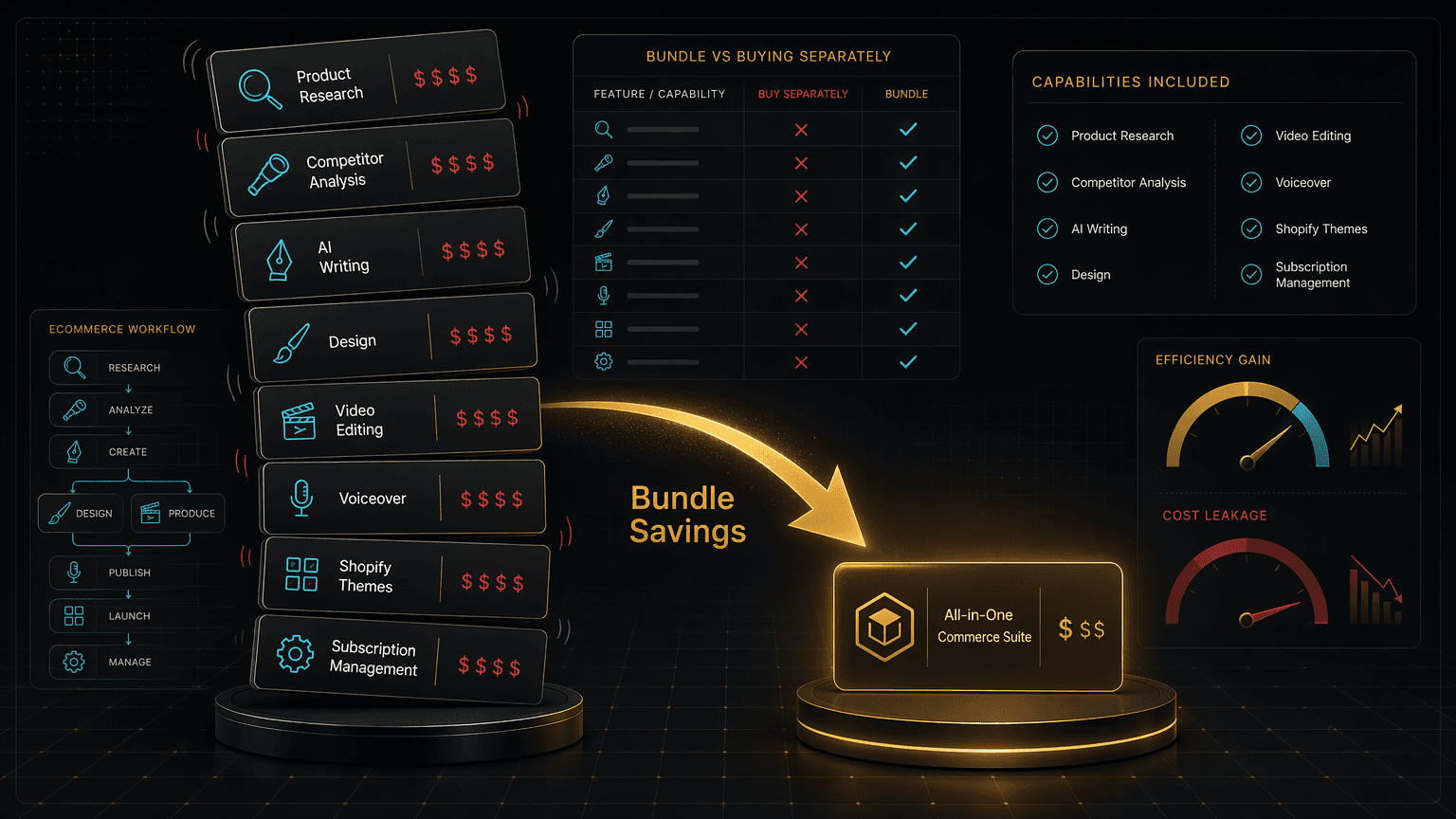
Ecom Tools vs buying tools separately: the same stack runs about $245/month at retail versus $29.99. Here is the honest price table and what you give up.
The same tools bought direct run about $245 a month at retail. The bundle is $29.99. Here is the honest math, and the three things the cheap price costs you.
By Maxime Yao, research editor | Published 2026-07-17
You are looking at a $29.99 bundle and a quiet voice says: a bundle can't beat picking my own tools. Real operators build their own stack. They pay for the exact accounts they need, in their own name, and they do not rent a pile of shared logins off a Discord. Bundles are for people who cannot be bothered.
That voice is confident. It is also mostly wrong about the one thing it feels most sure of: the money. Because "pick my own tools" has a price tag, and almost nobody adds it up before they say it. So let us add it up. The exact same named tools, bought direct, at the entry tier a solo operator would actually choose. Then the honest other side, because the bundle is not free of strings, and the strings are the whole story.
- The one number: the eight named tools bought separately at entry tiers total about $244.89 a month at retail (illustrative, based on published retail prices; verify current pricing). The bundle is $29.99 a month. That is roughly one-eighth the price.
- The lie: "a bundle can't beat picking my own tools." On raw cost, it beats it by about $215 a month.
- The catch: buying direct gives you your own account, full vendor support, and zero licensing risk. The group-buy bundle gives you none of those. That gap, not the dollar gap, is the real decision.
- The proof: 7,887 joined on Whop, 4.8 stars from 182 verified reviews, 92% five-star.
- The verdict: it nets out differently for a beginner, a scaling operator, and a single-tool-dependent pro. Find your row.
The lie: a bundle can't beat picking my own tools
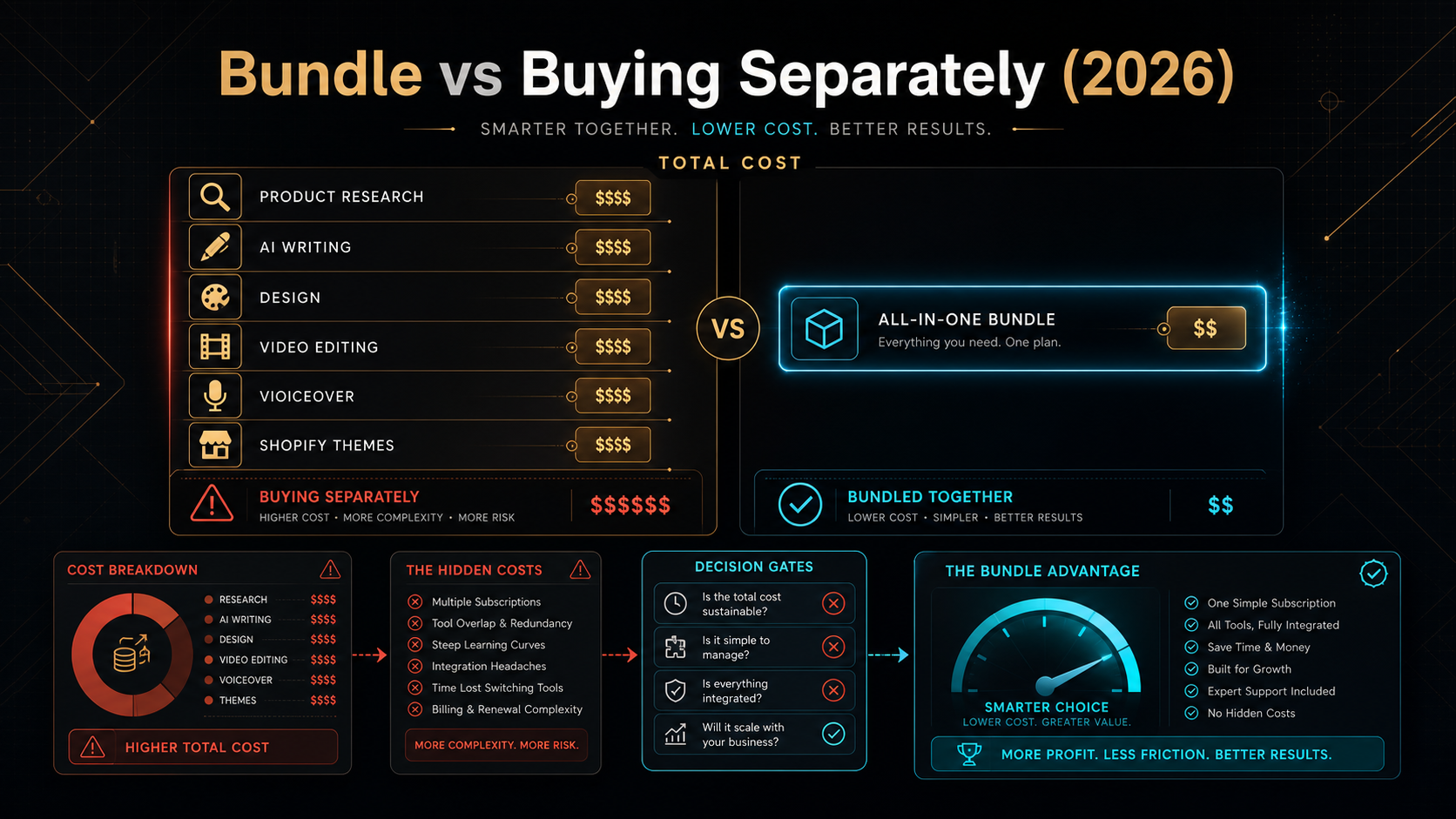
The belief feels like discipline. Own your stack. Control your accounts. Do not depend on some reseller. It sounds like the advice a serious operator gives, and in one narrow sense it is correct. But it smuggles in a hidden claim, and the hidden claim is false.
The hidden claim is that "picking your own tools" is roughly the same money as the bundle, so you might as well do it properly and buy direct. That is the part nobody checks. People compare the bundle's $29.99 against a fuzzy feeling of what tools "should" cost, land on "eh, probably similar," and buy direct on principle. Then the card statements arrive, one vendor at a time, and the real number never gets assembled in one place. Fifty here. Forty-nine there. Twenty for the AI. It never feels like $245 because it never lands as $245. It lands as eight separate small betrayals of your budget.
The fix is boring and devastating: put every line item in one table and total it. Not the feeling. The invoice. Once the real retail sum sits in a single column, the "a bundle can't beat picking my own tools" belief does not survive contact with arithmetic. It gets beaten by about $215 a month. What it does NOT tell you is what that $215 buys you back, which is the honest half of this piece and comes right after the number.
The fix: add up the real retail cost of the same stack
Here is the stack. These are the named, verified tools inside the Ecom Tools bundle: PipiAds, ShopHunter, KaloData, Canva Pro, CapCut Pro, ElevenLabs, ChatGPT Plus, and Claude Pro, alongside 140+ Shopify themes and other tools. To buy direct, you pay each vendor separately, at the entry tier a solo operator would realistically pick. Prices below are the current published retail figures with each source named. Treat the three ecommerce spy tools as directional and confirm them on the official pricing page, because those vendors move prices often and block clean automated checks.
| Tool | What it does | Entry plan | Retail price | Source to verify |
|---|---|---|---|---|
| PipiAds | TikTok and Facebook ad spy | Basic | $49/mo | pipiads.com pricing |
| ShopHunter | Shopify sales tracking | Basic | $50/mo | shophunter.io pricing |
| KaloData | TikTok Shop analytics | Starter | $45.90/mo | kalodata.com pricing |
| Canva Pro | Design and image editing | Pro | $18/mo | canva.com pricing |
| CapCut Pro | Short-video editing | Pro (web) | $19.99/mo | capcut.com pricing |
| ElevenLabs | AI voiceover and cloning | Creator | $22/mo | elevenlabs.io pricing |
| ChatGPT Plus | AI writing and research | Plus | $20/mo | openai.com pricing |
| Claude Pro | AI long-context reasoning | Pro | $20/mo | claude.com pricing |
| Monthly total | ~$244.89/mo | illustrative sum | ||
| Annual total | ~$2,938.68/yr | illustrative sum |
That $244.89 monthly total is illustrative, based on published retail prices; verify current pricing before you rely on it. A few honest notes on the figures, because a total you cannot audit is just another marketing number:
- The three spy tools drift. PipiAds retired its old cheaper Starter plan for new users in 2025; Basic is now the entry at $49, per third-party pricing trackers, with the official page hard to fetch cleanly. ShopHunter Basic near $50 and KaloData Starter near $45.90 come from review sources, not a direct page read. Confirm all three at the source.
- The consumer tools are firmer. Canva Pro at $18, CapCut Pro at $19.99 on web checkout, ElevenLabs Creator at $22, ChatGPT Plus at $20, and Claude Pro at $20 are well corroborated as of mid-2026. Canva and CapCut apply regional pricing, so your local figure can differ. ChatGPT and Claude add local tax in some regions.
- Cheaper tiers exist, and they matter. ElevenLabs has a $6 Starter without professional voice cloning. Annual billing shaves roughly 20 to 30% off several of these. If you deliberately buy the cheapest possible version of each, you can pull the total down toward the $180s. It still does not get near $29.99.
- The themes are excluded. The 140+ Shopify themes are not in the total. Premium themes are one-time purchases in the low hundreds each on the Shopify Theme Store, so counting them would widen the gap, not narrow it. Leaving them out keeps the comparison conservative.
The number: about $245 versus $29.99
Eight tools. About $244.89 a month at retail. Roughly $2,938 a year. The bundle is $29.99 a month, about $360 a year. On raw price, buying direct costs you around 8x more for the identical named tools. Say it as a single sentence and the "a bundle can't beat picking my own tools" belief is finished: on cost, the bundle wins by about $215 every month.
But a price gap is not a verdict. It is the setup for the real question. If the bundle delivered the exact same thing as buying direct, at one-eighth the price, there would be no article to write and no honest reviewer left in the business. It does not deliver the same thing. It delivers the same tools with three things stripped out. Those three things are what your $215 a month actually buys when you go direct, and for some buyers they are worth every dollar. For the full method behind pricing a stack against a bundle, see the real SaaS savings calculator guide.
The honest other side: what buying direct actually buys you
This is the section a lazy affiliate would skip. It is the section that decides your purchase correctly. When you buy each tool direct, the extra money is not wasted. It buys three specific things the group-buy bundle cannot give you. Understand these, because they are the entire case for doing it the expensive way.
1. Your own account, in your own name
Buy direct and the account is yours. Your email, your password, your saved projects, your Canva brand kit, your ShopHunter watchlists, your ChatGPT chat history, your ElevenLabs cloned voice. Nobody else logs into it. Your work persists, privately, under your control. In the bundle, access is shared. You reach the tools through credentials the operator maintains and delivers via Discord. That means no password you own, no vendor relationship in your name, and a shared environment where your saved history is not truly private or truly yours. For a design draft or a throwaway ad script, shared is fine. For a cloned brand voice or a client's data, ownership matters.
2. Full vendor support and uptime you can escalate
Buy direct and when a tool breaks, you open a ticket with the vendor who built it, on an account they can see, with a service relationship they are contractually on the hook for. Buy through a bundle and your support line is the bundle operator, not the vendor. The Ecom Tools reviews are unusually strong on exactly this point, members repeatedly praise fast support, and that matters more for a group-buy than for anything else. But it is still one operator relaying access, not the vendor's own support desk standing behind your uptime. If a tool being down for a day would cost you real money, direct support is not a luxury, it is the product.
3. No licensing or terms-of-service risk
Buy direct and you are a normal paying customer inside the vendor's terms. Nothing about your access is contested. Group-buy access sits in a grey zone with the original vendors. Some tolerate shared accounts, some do not, and access to any single tool can pause or change if a vendor cracks down. You are not breaking a law, but you are depending on an arrangement the tool's owner did not sell you directly. That is a real, structural risk that buying direct simply does not carry. The full picture of what can go wrong is in the group-buy licensing and account-risk guide.
There is the honest trade, laid flat. Buying direct costs about $215 a month more and hands you ownership, first-party support, and zero licensing risk. The bundle costs $29.99 and hands you breadth, savings, and shared access with strings. Neither is a scam. They are two different products for two different buyers.
The side-by-side, no spin
| Dimension | Buy direct (your own stack) | Ecom Tools bundle |
|---|---|---|
| Monthly cost, same 8 tools | ~$244.89 (illustrative) | $29.99 |
| Annual cost | ~$2,938 (illustrative) | ~$360 |
| Account ownership | Yours, in your name | Shared credentials via Discord |
| Support | First-party vendor support | Bundle operator (praised as fast) |
| Licensing risk | None, you are a direct customer | Grey-zone, access can pause |
| Data and history | Private, persistent, portable | Shared environment |
| Breadth for the money | Pay per tool you add | 16+ tools for one flat fee |
| Best for | Mission-critical single tools | Wide, cheap experimentation |
Read that table honestly and you will notice neither column is empty. That is the point. If the bundle lost every row, it would be a scam. If direct lost every row, nobody would ever buy a subscription. The truth is a split decision, and which side wins depends entirely on who you are.
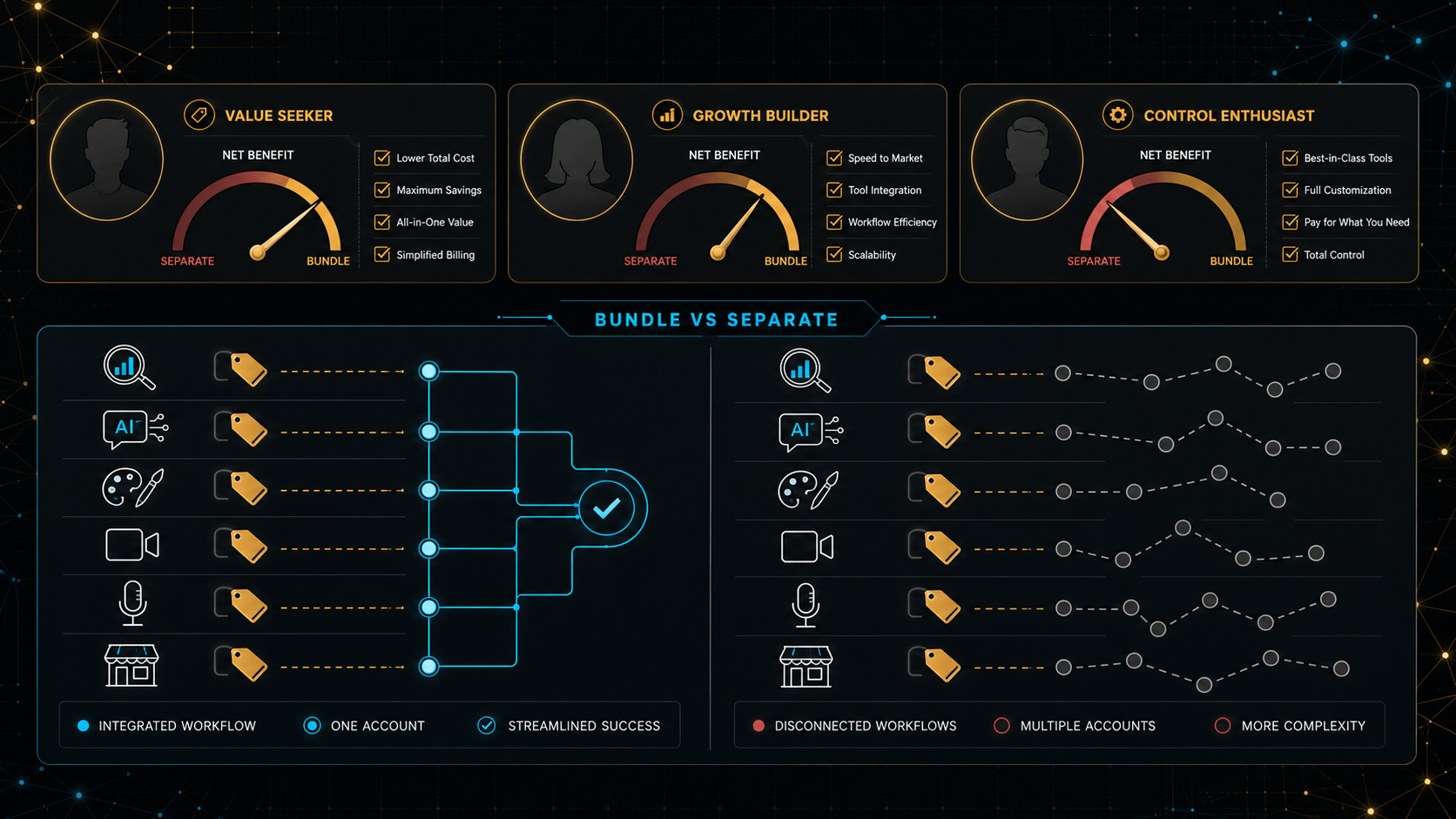
Net it out per buyer type
The average of all buyers is a useless answer. You are one specific operator. Find your row.
The beginner, testing the water
You are new. You have no ad budget deployed yet, you are not sure which of these tools you will even use, and $245 a month to find out is absurd. For you the bundle wins clearly. Its entire value is a cheap, wide test of the whole stack. Spend $29.99, open every tool, and learn which two or three you actually reach for before you commit a cent to a direct subscription. The shared-access strings barely matter yet, because you have no cloned voice, no client data, and no live operation to protect. Net: bundle, easily. When one tool becomes indispensable, revisit.
The scaling operator, running paid traffic
You are mid-flight. You run ads, you touch PipiAds or KaloData weekly, you cut video in CapCut, you draft with an AI model, and you are spending real money on traffic. For you it is genuinely close, and the smart move is often a hybrid. Use the bundle for breadth, the tools you touch occasionally, and buy direct for the one or two tools your operation cannot afford to have pause. Paying $29.99 for the wide stack plus one direct subscription for your non-negotiable tool is frequently the cheapest sane setup. Net: hybrid, bundle-led. The validation discipline behind which tools you actually need is in the product validation checklist.
The established pro or agency, tool-dependent
You have a live business, clients or a team, and one or two tools that are load-bearing. If ShopHunter or your AI model went dark for a day, you would lose money or miss a deliverable. For you, on those specific tools, buy direct. You need ownership, first-party support, and zero licensing risk on the tools that matter most, and $20 to $50 a month per tool is a rounding error against that certainty. But even you can run the bundle alongside, for the long tail of tools you use occasionally and do not want eight more invoices for. Net: direct for the critical few, bundle for the rest.
The single-tool minimalist
You genuinely use one tool. Just PipiAds, or just Canva Pro. Then the whole comparison collapses: buy that one tool direct, own it, and skip both the bundle and this debate. A bundle only wins on breadth. With a stack of one, there is no breadth to win. Net: direct, single subscription.
Where to be careful with the bundle
If your row points at the bundle, walk in with your eyes open. These caveats are the honest core of the deal, and the buyer who ignores them is the buyer who leaves an angry review.
- Shared access, not ownership. Worth repeating because it is the whole trade. You are renting access to accounts the operator maintains, not buying subscriptions in your name. Do not build a critical, irreplaceable process on a single shared login.
- The tool list can change. A bundle catalogue is a moving target as vendor deals shift. The 16+ count is the operator's current number. Verify the live catalogue at checkout rather than trusting any list, including this one, months from now.
- Outcomes vary. Access to sixteen tools is not access to sixteen results. PipiAds finds ads; it does not pick your winner. The tools are leverage, not a guarantee, and the work stays yours.
- The operator is semi-anonymous. Ecom Tools is run by a founder known in Whop reviews only as "Rony," who joined Whop in July 2023. There is no public surname, bio, or company-entity disclosure. The reviews are strong and specific, but you are trusting a first name and a track record, not a registered corporate vendor.
- Refund terms are not published. The operator does not publish refund terms, so review Whop's current refund policy at checkout before you pay, not after.
None of these kill the deal. They price it. A group-buy is a rental with real savings and real strings, and the strings are exactly why it costs $29.99 instead of $245.
How to test the bundle without gambling
De-risk it in a week before you cancel any direct subscription you already hold.
- Confirm the live catalogue. At checkout, read the current tool list and confirm the specific tools you came for are in it today.
- Check the free pass. Current verified facts do not show a Pro plan. Use the free Access pass to look around first, then verify the paid plan at checkout before you count on it.
- Open your one non-negotiable tool first. Test the single tool you would miss most and confirm the shared access works for your use, at your volume, before you trust it.
- Run one real workflow end to end. Research a product in KaloData, validate it in ShopHunter, draft the ad in ChatGPT or Claude, cut the video in CapCut. See if the assembly line holds in one sitting.
- Keep your critical direct account for now. Do not cancel the direct subscription for your load-bearing tool until the bundle has proven itself on that exact tool for a full billing cycle.
What real members say
Treat these as evidence from the Whop review page, not promises. The listing carries 4.8 stars from 182 verified reviews, 92% of them five-star, across 7,887 joined.
"The variety of tools available here on ecom-tools is unbelievable & no other tool provider is giving such fine services & customer support" Zain Khan (@zain60912)
"Great selection of tools and fastest support I have ever seen" Somira (@somiraa)
"Very convenient and helpful, they got the best and fastest support" Milad Massalha (@massalha)
The recurring word is support, and that is the right thing to stress-test for a group-buy. When shared access hiccups, response speed is the difference between an afternoon lost and a week lost. It does not replace first-party vendor support, but for a bundle it is the metric that matters most.
The verdict
| Buy the bundle if | Buy direct if |
|---|---|
| You use several tool categories and want breadth cheaply | You depend on one specific tool and need guaranteed uptime |
| You are testing which tools deserve a place in your stack | You need the account in your own name with private, portable data |
| $245 a month in separate subscriptions is not justifiable yet | First-party vendor support is non-negotiable for you |
| You accept shared access as the price of the savings | Group-buy licensing risk is a dealbreaker |
Here is the whole thing in one line. On money, the bundle wins by about $215 a month and it is not close. On ownership, support, and licensing safety, buying direct wins and it is not close. So the answer is not "which is better," it is "which do you need," and the buyer-type section above already told you. Most operators land on a hybrid: the bundle for breadth and experimentation, direct subscriptions for the one or two tools their business cannot afford to have pause. If you want the broader worth-it argument, read the Ecom Tools worth-it review.
FAQ
How much do the same tools cost bought separately?
At entry tiers, the eight named non-theme tools total about $244.89 a month at retail: PipiAds $49, ShopHunter $50, KaloData $45.90, Canva Pro $18, CapCut Pro $19.99, ElevenLabs Creator $22, ChatGPT Plus $20, and Claude Pro $20. That figure is illustrative, based on published retail prices; verify current pricing. It excludes the 140+ Shopify themes, which are one-time purchases in the low hundreds each. The bundle is $29.99 a month.
If the bundle is so much cheaper, what is the catch?
Three things. You do not own the accounts, they are shared credentials delivered through Discord. Your support is the bundle operator, not the tool's own vendor. And group-buy access carries licensing and terms-of-service risk, so access to any single tool can pause if a vendor cracks down. Buying direct costs about $215 a month more and removes all three of those.
Is buying direct ever the smarter move?
Yes, for tools your operation cannot afford to have interrupted. If a tool going dark for a day would cost you real money or a client deliverable, buy that specific tool direct for the ownership, first-party support, and zero licensing risk. Many operators do both: direct for the critical one or two tools, the bundle for the rest.
Can I use the bundle and direct subscriptions together?
That hybrid is often the cheapest sane setup for a scaling operator. Run the bundle for breadth, the tools you touch occasionally, and keep a direct subscription for the single tool you depend on most. You pay $29.99 plus one direct fee instead of eight direct fees, and you protect your one non-negotiable tool.
Is there a free Access pass or a refund on the bundle?
Current verified facts do not show a Pro plan. Use the free Access pass to look around first, then verify the paid plan at checkout. Refund terms are not published by the operator, so review Whop's current refund policy at checkout before you pay.
The decision filter
If you touch three or more of these tool categories every month and you can live with shared access as the price of the savings, start on the Pro plan and test the fit: Ecom Tools Pro, $29.99/month. If you would rather commit once, the Lifetime plan is $499 one-time. If your business leans on one specific tool and a paused login would break it, buy that tool direct, own it, and skip the bundle for that slot. The dollar gap is real. So are the strings. Match the tool to the job and the choice makes itself.