The dropshipping product validation checklist for 2026
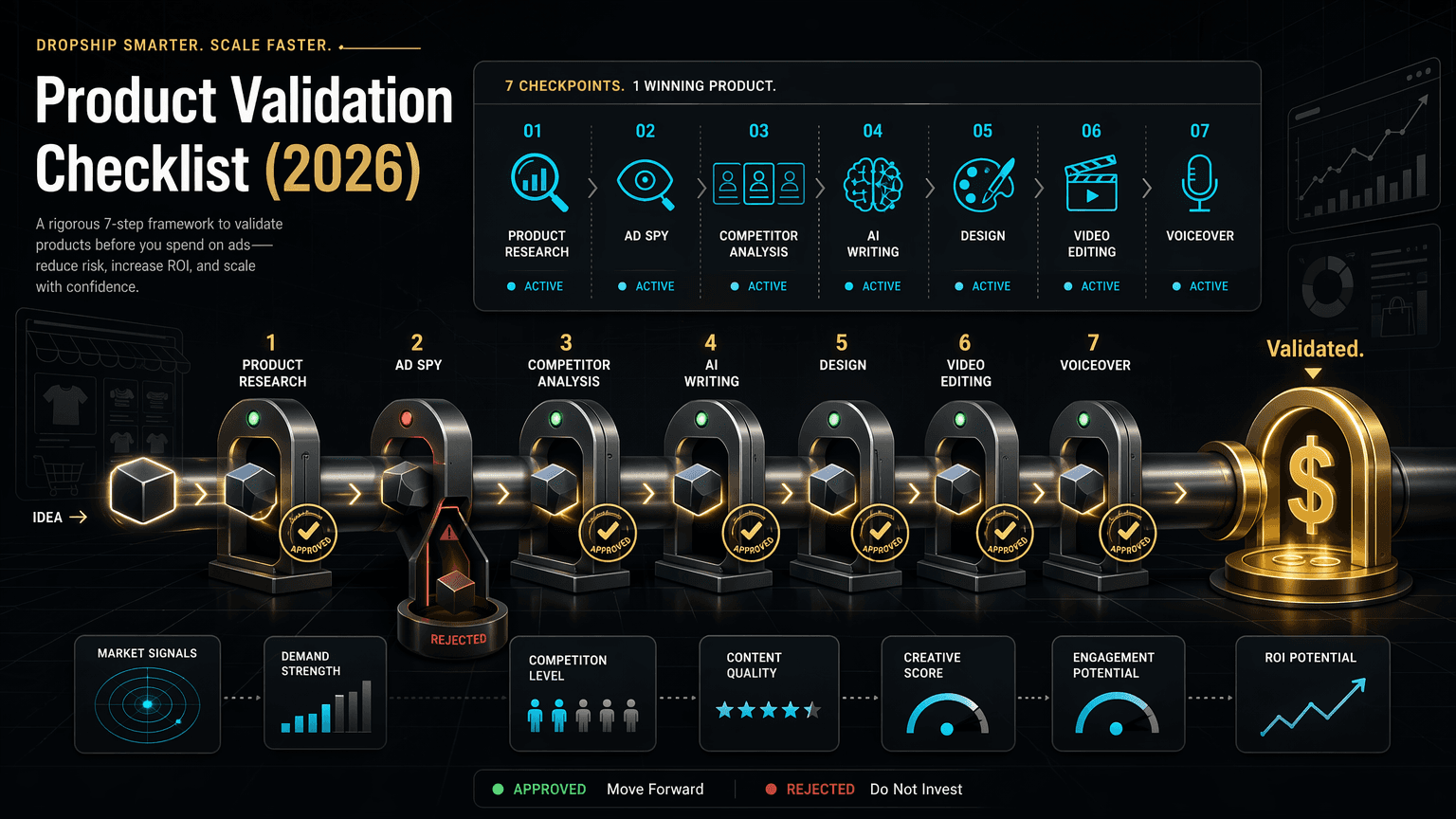
Trending is not the same as winning. Run every product through these seven gates before you spend a single dollar on ads, or the ad account eats you alive.
Trending is not the same as winning. Run every product through these seven gates before you spend a dollar on ads.
By Maxime Yao, research editor | Published 2026-07-17
A product goes viral on your feed. Ten stores are running it. Your gut says go, and your card is already reaching for the ad budget. Stop. That feeling is the single most expensive reflex in dropshipping, because a trending product and a profitable product are two different things, and the gap between them is measured in burned ad spend.
Here is the lie this checklist kills: trending equals winning. Here is the fix: seven gates every product must pass before a dollar of ad spend. And here is the one number that keeps you honest through all of them: your projected ad cost has to stay under about 30% of revenue, or the unit economics never close no matter how good the video looks.
We will run one worked example through every gate: a weighted sensory plush toy, priced around $34, sourced at roughly $9 landed. Watch it either pass or die at each step.
TL;DR
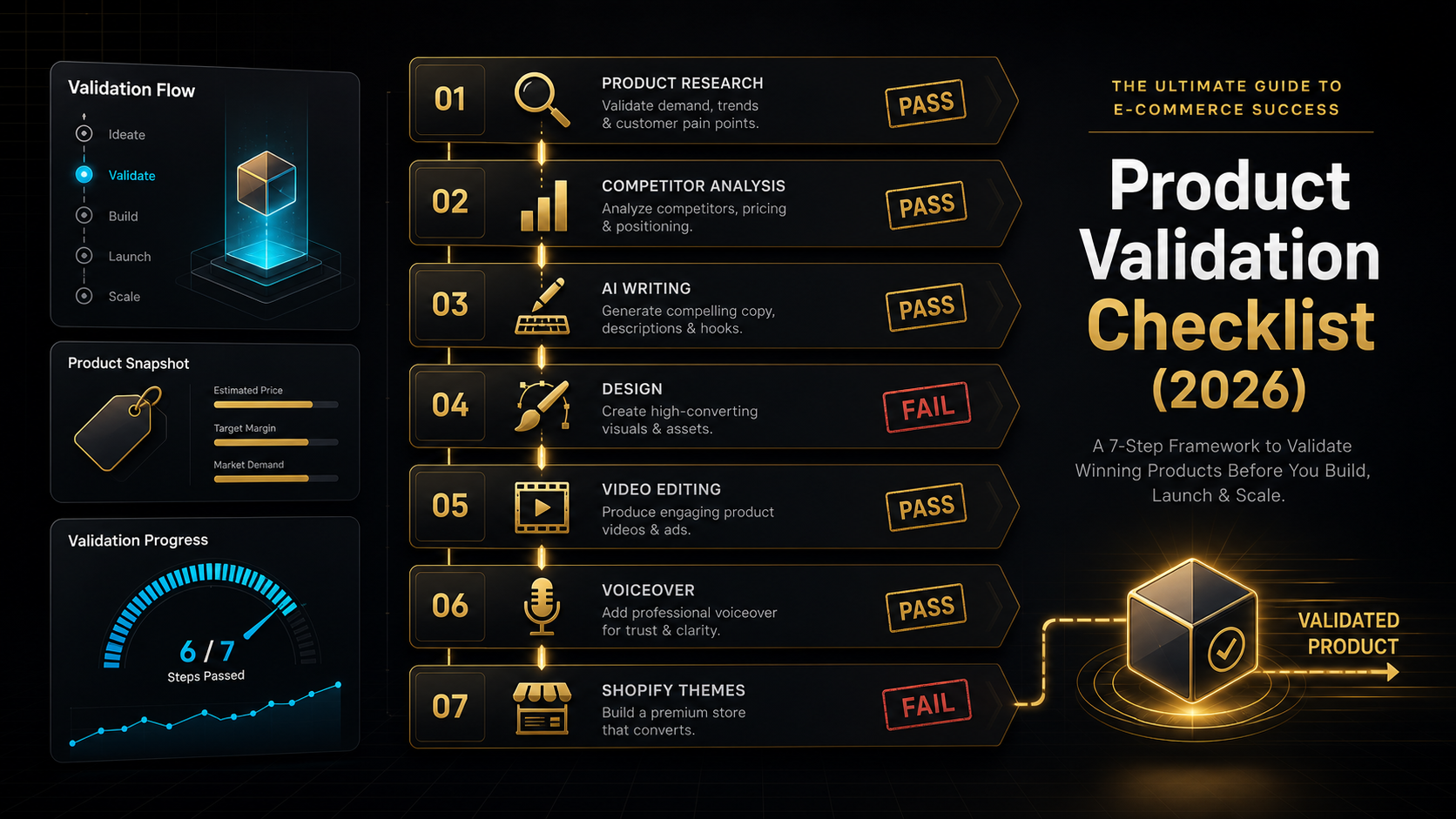
- Trending is a demand signal, not a profit signal.
- Seven gates: demand, margin, differentiation, supplier, shipping, ad angle, compliance.
- Keep projected ad cost under about 30% of revenue or the math never closes.
- Ad-spy tools tell you what is running, not what is profitable.
- If a product fails one gate, you pivot. One failed gate is enough.
Why most products fail before the first sale
Industry estimates commonly cite that only a small minority of dropshipping stores stay profitable long term, and the usual reason is not the market. It is that operators validate emotionally and pay for it with their ad account. They see engagement, assume demand, skip the margin math, and discover on day nine that the winning product loses money on every unit. The checklist below turns that emotional yes into a structured one.
Gate 1: is there a real demand signal,
You need evidence that people want this, beyond one viral clip. Confirm the interest is stable or rising, not a single spike that already peaked. Google Trends should show a steady or climbing line on the core term. Ad-spy tools like PipiAds and ShopHunter should show ads that have been running for weeks, not days, because longevity is the closest free proxy for a profitable campaign. KaloData can confirm TikTok Shop demand if that is your channel.
Plush example: the term shows a steady multi-month climb, and PipiAds shows several ads live for over 30 days. Pass. But note the honest limit, which we cover in what ad-spy data can and cannot prove: a long-running ad signals demand, not confirmed profit.
Gate 2: does the margin math actually close,

This is the gate that kills the most products, and the one beginners skip. Write it out. Sell price minus product cost minus shipping minus payment fees minus projected ad cost per order. If the number after all of that is not comfortably positive, the product is dead, full stop.
The anchor is your breakeven ad cost. If you sell at $34 with $9 landed cost and roughly $3 in fees, you have about $22 of gross margin per unit before ads. To keep ad cost under 30% of the $34 revenue, you need a cost per acquisition under about $10. That is your line in the sand.
| Line item | Per order |
|---|---|
| Sell price | $34.00 |
| Product plus shipping cost | $9.00 |
| Payment fees | $3.00 |
| Target ad cost (under 30%) | under $10.00 |
| Contribution left | around $12.00 |
Plush example: the math leaves about $12 per unit if you hold CPA under $10. Pass, conditionally. The condition is that your real CPA comes in under $10, which only testing proves.
Gate 3: can you differentiate, or are you the tenth identical store,
If ten stores run the identical product, identical creative, and identical price, you are competing on ad budget alone, and someone with deeper pockets wins. You need an angle: a bundle, a better creative hook, a specific audience, a perceived-value upgrade. Same product, different wrapper.
Plush example: instead of the generic listing, you bundle it as a sleep-and-anxiety aid for a specific audience with a calming-routine angle. Pass. No angle, no pass.
Gate 4: is the supplier reliable,
A winning product with a flaky supplier is a refund machine. Confirm at least two or three suppliers can fulfill, check their order history and ratings, and order a sample yourself before you scale. Reliability here protects the metric that quietly destroys stores: the refund and chargeback rate. Industry data puts average ecommerce return rates in the high teens to low twenties as a percentage, and chargebacks that drift toward 1% put your payment processing at risk. A bad supplier pushes both the wrong way.
Plush example: three suppliers, solid ratings, a sample that matches the photos. Pass.
Gate 5: is shipping time survivable,
Long shipping times drive refunds and disputes. In 2026, buyers expect fast, and a 25-day delivery window is a chargeback waiting to happen. Prefer suppliers with local or regional fulfillment, or set expectations ruthlessly clearly on the product page if times are long.
Plush example: a supplier offers 7 to 10 day fulfillment to your main market. Pass. A 30-day-only option would fail this gate outright.
Gate 6: does a real ad angle exist,
Can you actually make a scroll-stopping creative for this, A product with no visual demo, no obvious hook, and no emotional trigger is hard to sell no matter how good the margin. The best products demonstrate themselves in three seconds. Your creative stack matters here, and a bundled toolset covers it end to end, which we detail in the AI creative workflow for ecommerce ads.
Plush example: the weighted, sensory feel demonstrates instantly on camera with a clear before-and-after calm hook. Pass.
Gate 7: does it clear compliance,
Some products invite trouble: health claims, safety-regulated categories, trademarked characters, restricted ad categories. If a product forces you to make claims you cannot back, or falls in a category the platforms restrict, the account risk is not worth it. Check platform policy before you build.
Plush example: avoid medical claims, market it as comfort and relaxation rather than treatment, and it clears. Pass. Had the angle required a health claim, it would fail.
The scorecard: one fail is a pivot
Seven gates, pass or fail, no partial credit. The plush toy passed all seven, so it earns a test budget. If it had failed even one, demand too thin, margin too tight, no angle, bad supplier, slow shipping, no creative, or a compliance landmine, you pivot before spending, not after.
| Gate | Question | Plush |
|---|---|---|
| 1 Demand | Stable or rising, long-running ads, | Pass |
| 2 Margin | CPA under 30% of revenue, | Pass |
| 3 Differentiation | Real angle, not identical, | Pass |
| 4 Supplier | Two-plus reliable, sampled, | Pass |
| 5 Shipping | Survivable delivery time, | Pass |
| 6 Ad angle | Demonstrable in three seconds, | Pass |
| 7 Compliance | Clears platform policy, | Pass |
Where the bundle tools fit
Gates 1 and 2 lean on research tools. PipiAds and ShopHunter for ad longevity and competitor storefronts, KaloData for TikTok Shop demand, all available inside a group-buy bundle. That said, remember what these tools are: a demand signal, not a profit guarantee. And if you are weighing whether a bundle beats buying each tool alone, the honest calculation is in how to calculate real SaaS savings. If you want to test that research stack cheaply, start on the Ecom Tools Pro plan and validate the fit before committing.
The honest caveats
- These gates lower risk, they do not remove it. A product can pass all seven and still lose in-market. Outcomes vary with execution, budget, and timing.
- Ad-spy data is directional, not proof of another store's profit. Use it to shortlist, not to copy blindly.
- The benchmarks here are industry estimates. Verify current return-rate and fee figures against your own market and processor.
The five most expensive validation mistakes
The gates above catch most bad products. These five habits are how good operators still lose money, because each one lets a product skip a gate it should have failed.
- Validating on engagement instead of longevity. A million-view video means the hook works, not that the funnel is profitable. A creative that has run for six weeks is worth far more as a signal than one that went viral yesterday and may already be losing money. Weigh how long ads survive over how loud they were.
- Using the sell price as the margin. Beginners see a $40 product with a $9 cost and imagine $31 of margin. Then fees, shipping, refunds, and ad cost quietly eat most of it. Always run the full per-order math down to contribution, never the headline spread.
- Ignoring the refund tail. A product that sells hard and returns hard can look like a winner for two weeks and a disaster by day 40. Cheap, fragile, or over-promised products carry a hidden refund cost that never shows in an ad-spy tool. Sample the product and read reviews of the same item on marketplaces before you scale.
- Skipping differentiation because the product is hot. The hotter the product, the more crowded the field, and the later you are arriving. Without an angle you are buying the same clicks as ten better-funded stores. Hot plus generic is a losing combination.
- Confusing a supplier photo with a supplier. A clean product image is not proof of reliable fulfillment. Order the sample, time the delivery, and confirm a backup supplier exists before a single ad runs.
A second margin example: the product that fails gate two
Not every candidate survives. Take a mid-priced kitchen gadget: sell price $28, landed cost $12, fees around $3. That leaves roughly $13 before ads. To hold ad cost under 30% of $28 you need a CPA under about $8.40. In a saturated category where every competitor is bidding on the same audience, an $8.40 CPA is optimistic, and if your real CPA lands at $14, you lose money on every order while the dashboard shows rising revenue.
| Line item | Gadget | Verdict |
|---|---|---|
| Sell price | $28.00 | |
| Cost plus fees | $15.00 | |
| Required CPA (under 30%) | under $8.40 | hard in a crowded niche |
| Realistic CPA | around $14.00 | fails |
This is the value of running the math before the ads. The gadget looked fine on a spy tool, showed real demand, and still fails on unit economics. You just saved the ad budget you would have spent proving it the expensive way. That is the entire point of validating before launch rather than during it, and it is why the store launch sequence keeps validation ahead of building, as laid out in the store launch workflow.
Reading the demand signal without fooling yourself
Demand evidence sits on a ladder of reliability. At the bottom is a single viral clip, which proves almost nothing. Above it, multiple advertisers running the product, which shows broad appeal but also warns of saturation. Higher still, ads that have survived for many weeks, the strongest free signal because losing ads get switched off. At the top, your own small test with real conversion data, which is the only signal that actually proves profit for you. Climb the ladder before you commit. Most failed launches were built on the bottom rung and never checked the top one. The research tools in a bundle, PipiAds and ShopHunter for longevity and KaloData for TikTok Shop demand, are how you gather the middle rungs quickly, but they never replace the top rung, which only your own numbers provide.
When judgment overrides the checklist
A checklist is a floor, not a ceiling, and there are moments when experience earns you the right to weigh a gate differently. If a product fails the differentiation gate on paper because several stores already run it, but you hold a genuinely superior creative angle and a tighter offer, that is not the same as blindly copying a saturated winner. The gate exists to stop you competing on budget alone, and if your angle removes that problem, you have satisfied the intent of the gate even if the surface reading said fail. The same is true of the margin gate for products with a strong repeat-purchase or bundle tail. A thin front-end margin can be acceptable when a reliable back-end offer lifts the lifetime value of each customer, which is exactly the hidden economics that makes some competitors profitable on ads that look impossible to sustain. The discipline is not to abandon the gates, it is to understand why each one exists so you know when a real, specific reason lets you weigh it differently. Beginners should run the checklist literally until they have enough live data to trust their own judgment, because the fastest way to go broke is to grant yourself exceptions you have not earned. Every override should come with a written reason and a tighter test budget, not a shrug and a hunch. If you cannot articulate in one sentence why a failed gate does not apply to your specific situation, the gate applies and the product waits.
There is also a timing dimension the checklist does not capture directly. A product that fails the demand gate today because interest is flat may pass it in three months as a season turns, and a product that passes today may be a week from saturation. Validation is a snapshot, so date your findings and revisit them, especially for seasonal or trend-driven products where the window that decides everything can open and close in weeks. Treat the checklist as a living filter you re-run, not a one-time stamp, and pair it with the sequenced launch loop so that validation always sits fresh and immediately ahead of the money you are about to spend.
FAQ
How many gates can a product fail and still be worth testing?
Zero. The point of the checklist is that a single failed gate is a structural problem the ad budget cannot fix. Pivot instead.
What is a good cost per acquisition target?
Work backward from margin. Keep ad cost under about 30% of revenue. On a $34 product that means a CPA under roughly $10, but the exact line depends on your product cost and fees.
Do I need paid ad-spy tools for this?
They speed up gates 1 and 2 considerably, but you can start with Google Trends and manual research. Paid tools like PipiAds and ShopHunter show ad longevity and competitor stores faster.
Does a long-running competitor ad prove the product is profitable?
No. It signals durable demand, which correlates with profit but does not prove it. You cannot see the competitor's margin, refund rate, or true return on ad spend.
How long should I test before killing a product?
Set a budget and a CPA ceiling before you launch, and hold to it. If real CPA runs well above your breakeven line with no path to improve, the test has answered you.
The one-line decision filter
If a product fails one gate, pivot. If it passes all seven, give it a disciplined test budget with a hard CPA ceiling, and let the numbers, not the hype, make the call.