Ad spy data: what it can and cannot prove in 2026
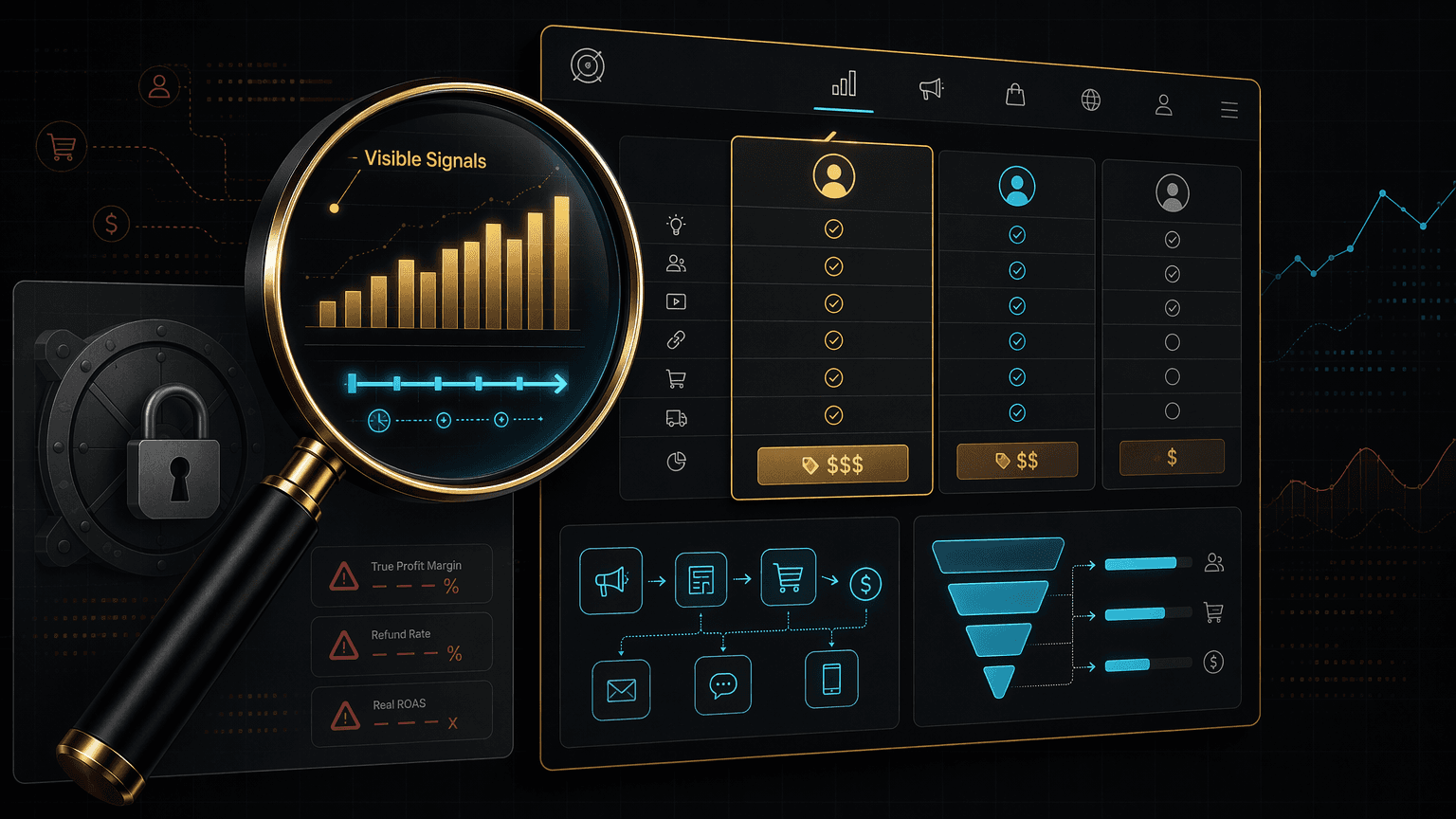
A product running a wall of ads looks like a winner. It is not proof of profit. Here is exactly what ad-spy tools measure, and what they quietly hide.
A product running a wall of ads looks like a winner. It is not proof of profit. Here is what ad-spy tools measure, and what they hide.
By Maxime Yao, research editor | Published 2026-07-17
You open an ad-spy tool, find a product with dozens of live ads and huge engagement, and conclude it must be printing money. So you copy it. Same product, same creative, same price. Two weeks later your account is down and theirs is still running. What happened,
What happened is you read the data as a verdict when it was only a clue. Here is the lie: a product running a lot of ads must be profitable, so copy it. Here is the fix: understand precisely what ad-spy tools measure and what they cannot see. The reframe that settles it: ad spend and ad longevity signal demand, they do not prove profit. Those are not the same thing, and mistaking one for the other is the most expensive misread in product research.
TL;DR
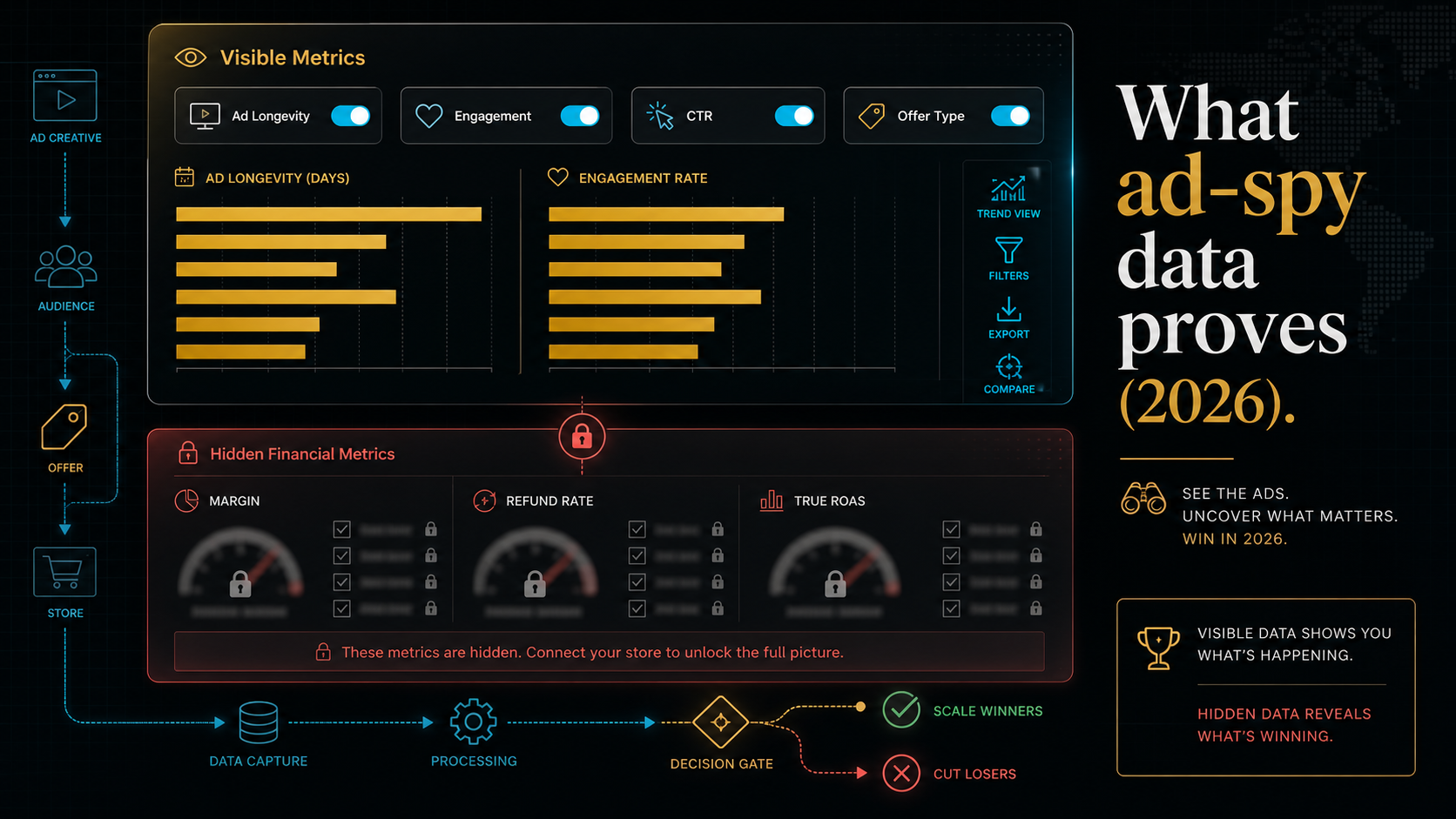
- Ad-spy tools show what is running, not what is profitable.
- Longevity is the best free signal, because losing ads get turned off.
- They cannot see margin, refund rate, or true return on ad spend.
- Use spy data to shortlist candidates, then validate. Never copy blindly.
- Copying a saturated winner puts you in the worst possible position: late.
What ad-spy tools actually show
Tools like PipiAds and ShopHunter are genuinely useful. They surface real, observable signals that would take you hours to gather manually:
- Ad longevity. How long an ad has been running. This is the strongest free signal, because a rational advertiser turns off ads that lose money. A creative live for 45 days is very likely working for someone.
- Engagement. Likes, comments, shares on the ad creative. A rough proxy for how the market reacts to the hook.
- Landing pages and offers. The store, the price, the offer structure a competitor is using.
- Estimated spend and reach. A modeled guess at scale, useful directionally.
That is real intelligence. It tells you demand exists and shows you how a competitor is packaging it. If you want that research stack cheaply, a group-buy bundle carries these tools, and you can test it on the Ecom Tools Pro plan first.
What they quietly hide
Here is the part beginners miss. Everything that actually determines profit is invisible to a spy tool:
- True margin. You cannot see the competitor's product cost, so you cannot know if they make $15 or $1.50 per order.
- Refund and chargeback rate. A product can sell hard and hemorrhage on returns. Average ecommerce return rates commonly sit in the high teens to low twenties as a percentage, and a bad product can run far higher, none of which shows in an ad.
- True return on ad spend. Longevity suggests an ad is not losing badly, but it does not tell you whether the campaign is wildly profitable or barely breaking even while the operator waits for a repeat-purchase tail.
- Whether they are actually profitable at all. Some operators run at a loss to build data, clear inventory, or feed a back-end offer you cannot see.
| Signal | What it proves | What it does not prove |
|---|---|---|
| Ad running 45 days | Durable demand exists | That it is profitable, or by how much |
| High engagement | The hook resonates | That clicks convert to profitable sales |
| Many advertisers | The product has broad appeal | That there is room left for you |
| Estimated high spend | Someone is scaling it | Their real margin or return on ad spend |
The saturation trap
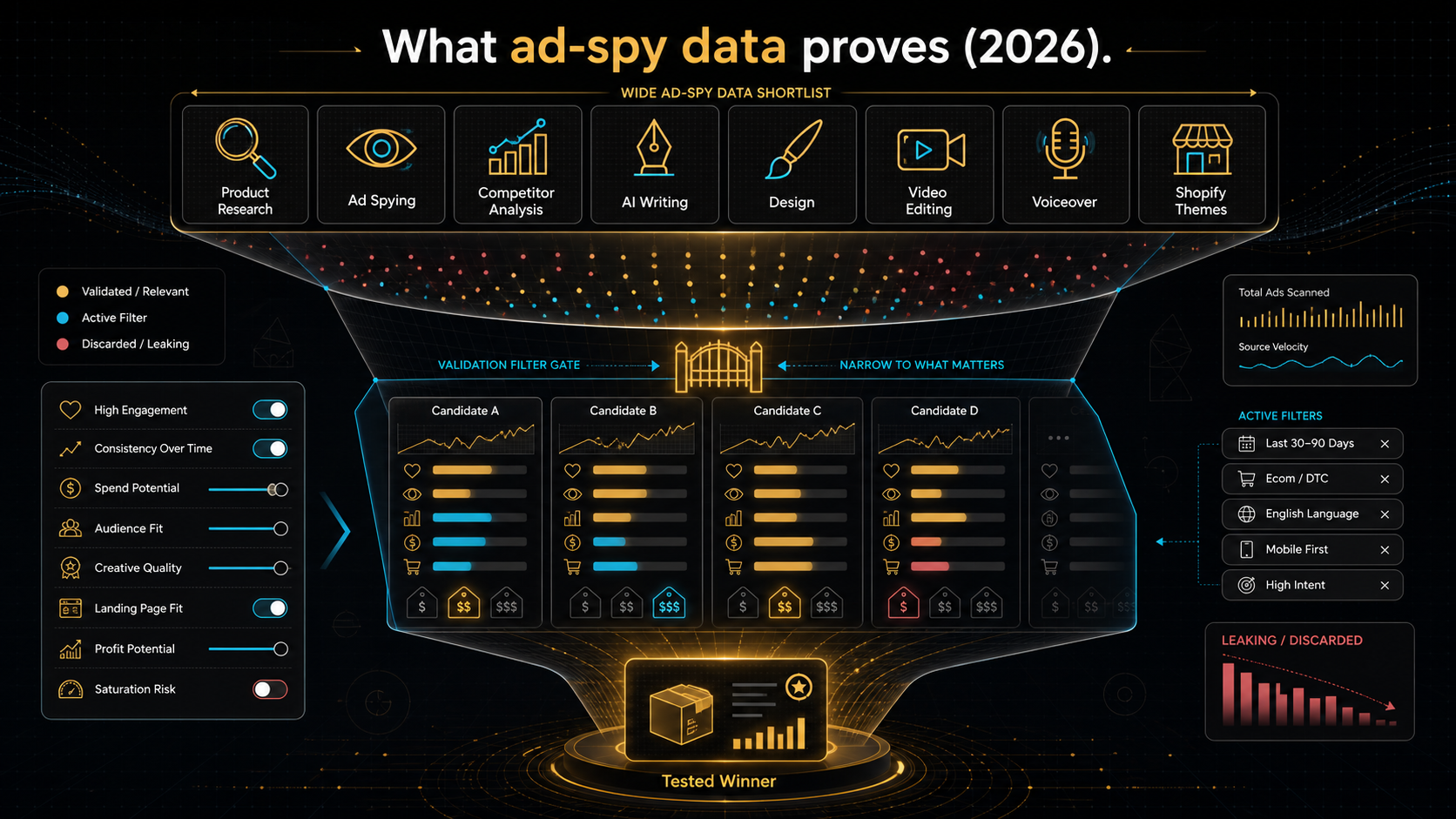
There is a second, sharper danger. The moment a product is easy to find in a spy tool, so can every other dropshipper find it. If dozens of stores are already running the identical product and creative, copying it puts you in the worst seat in the room: last in, competing on ad budget against operators who got in early, built data, and drove their costs down. The visibility that makes spy data useful also makes the obvious winners crowded.
The way out is not to avoid popular products, it is to bring a real angle, which is gate three of the product validation checklist. Same product, different audience, better hook, stronger offer.
How to use ad-spy data the right way
Treat spy data as the top of a funnel, not the bottom line.
- Shortlist. Use longevity and engagement to find candidates worth a closer look. This is what the tools are genuinely great at.
- Validate. Run each candidate through the full validation checklist, especially the margin gate, which the spy tool cannot answer for you.
- Differentiate. Assume the obvious version is saturated. Find the angle that is not.
- Test with your own numbers. Only your CPA against your margin proves profitability. The competitor's ad never will.
Where this fits in the stack
Ad-spy tools are one input into a larger loop. They feed the shortlist, the validation checklist filters it, and your own launch data delivers the verdict. If you are deciding whether to access these tools through a bundle or buy them direct, the honest cost comparison is in how to calculate real SaaS savings, and the analytics that actually judge a launch are in the metrics glossary.
The honest caveats
- Estimated spend and reach figures in spy tools are models, not audited numbers. Treat them as directional.
- Longevity is a strong signal but not a guarantee. Advertisers occasionally run losing ads longer than they should.
- Benchmark return rates cited here are industry estimates. Verify against your own category and market.
A worked example of misreading spy data
Watch how the trap springs. You find a posture corrector with 40 live ads, one running 60 days, huge comment counts, and an estimated spend that looks enormous. Every visible signal screams winner, so you copy the product, the creative, and the $39 price, and you launch.
Here is what the tool never showed you. The original operator sources the product at $6 and runs it as a loss leader into a $79 back-end bundle you cannot see, so their front-end CPA can run high and still be profitable. You have no back end. Their 60-day ad is profitable because of a funnel you did not copy. Meanwhile the product carries a high return rate because it rarely fits as promised, and returns quietly erase the margin you assumed. You are now late into a saturated field, running a loss leader with no back end, on a product that returns hard. The spy tool did not lie. You read a demand signal as a profit guarantee.
| What you saw | What was true |
|---|---|
| 60-day ad, must be printing money | Profitable only via a hidden back-end offer |
| Huge engagement, easy sales | High return rate erased the margin |
| Many advertisers, big market | Saturated, and you arrived last |
| High estimated spend | A model, not their real return on ad spend |
What each research tool is genuinely best at
Spy and research tools are not interchangeable. Used for their strengths, they build a fast, honest shortlist. Used as verdict machines, they mislead.
- PipiAds. Strongest for TikTok-style ad discovery and longevity. Best use: find creatives that have survived, then study the hook, not the product alone.
- ShopHunter. Strongest for reading competitor storefronts and sales signals. Best use: understand how a proven store packages an offer, then build a better angle rather than a copy.
- KaloData. Strongest for TikTok Shop demand and trend data. Best use: confirm a product has real, durable interest on the channel you actually sell on.
Notice the pattern. Every honest use ends in the same place: a shortlist you then validate with your own margin math and your own test. None of them ends in copy this and scale. If you want that research stack without paying for three separate subscriptions, a group-buy bundle carries all three, and the honest cost comparison against buying them direct is in how to calculate real SaaS savings.
How experienced operators use spy data differently
The difference between a beginner and a seasoned operator is not access to better tools, it is what they ask the tools for. A beginner asks, what should I sell, and copies the answer. A pro asks, what is the market already responding to, and then asks a second question the beginner skips: what angle is nobody running yet. The pro treats every visible winner as a saturated starting point, not a finish line, and spends the real effort on differentiation and their own unit economics. They use the tool to compress research from hours to minutes, then spend the saved time where the money actually is: the angle, the margin, and the test. That reframe, from answer machine to shortlist machine, is the entire skill, and it is why the same tool makes one operator money and costs another their ad budget. It also feeds directly into gate three of the validation checklist, where a real angle separates a viable launch from a late copy.
The psychology of the copy trap
Understanding why the copy trap is so seductive is half of escaping it. Ad-spy tools give you the feeling of certainty without the substance of it. You see a wall of live ads and your brain reads consensus, and consensus feels safe. The heuristic is ancient and usually useful: if many people are doing something, it probably works. But in a competitive ad market that same instinct is precisely backward, because the visibility that reassures you is the same visibility that guarantees the field is crowded. The comfort of copying is that it feels like the decision has already been validated by others, which relieves you of the hard, uncomfortable work of judging margin, building an angle, and risking your own budget on an unproven test. That relief is exactly the problem. The market does not reward the operator who felt most certain, it rewards the one who did the analysis everyone else skipped because it was uncomfortable. Every time you feel the pull to copy a winner wholesale, treat that pull as a signal that you have found a crowded product, not a safe one, and redirect the energy into the angle and the unit economics that the crowd is ignoring.
There is a quieter cost, too. Every hour spent hunting for the perfect product to copy is an hour not spent building the skill that actually compounds: reading a market, crafting a hook, and understanding your own numbers. The tools are a lever for research, but a lever with nothing to push against does nothing. Operators who lean on spy data as a crutch stay dependent on finding the next winner to copy, forever one step behind, while operators who use it as one input into their own judgment slowly build the ability to see an angle before the crowd does. That capability, not any single product, is the real asset.
Building your own signal over time
The strongest research asset you can own is not a subscription, it is a growing bank of your own tested data. Every launch, win or lose, teaches you something a spy tool never could: how your specific audience responds, what hooks convert for your niche, what your real CPA and return rates look like in practice. Over months this private dataset becomes more valuable than any competitor intelligence, because it is about the only market you actually control, yours. Spy tools are best understood as the fast on-ramp for someone who does not yet have that private signal, a way to compress early research from hours into minutes while you accumulate the real thing. Treat them as scaffolding, not foundation. Use them to shortlist quickly, validate rigorously with your own math, test with disciplined budgets, and file every result. The operators who last are the ones who graduate from copying what is visible to trusting what they have personally proven, and the tools are simply the ladder that gets them started, not the house they live in.
Timing and the shelf life of a signal
One more limit deserves its own warning, because it catches even careful operators: the signal you read in a spy tool has a shelf life, and it is often shorter than you think. By the time a product is visible enough for you to find it easily, it has already been discovered by the operators who move fastest, which means the demand you are reading may be closer to its peak than its start. Trend-driven and seasonal products are the sharpest version of this. A creative that has run profitably for six weeks is strong evidence of past demand, but past demand is not future demand when a trend is rolling over or a season is ending. The tool shows you where the market has been, not where it is going, and the gap between those two is where late entrants lose. The defense is to date every observation and to weight fresher, still-climbing signals over older ones that may be describing a wave that has already broken. Pair the spy read with an independent demand check, a steady or rising interest trend rather than a spike that already crested, so you are not buying into the tail end of something. And accept the uncomfortable truth that the very best products often do not sit obviously at the top of a spy tool waiting to be copied. They are found by operators reading the market a step earlier and building an angle before the crowd arrives. The tool accelerates that reading, but it cannot do it for you, and treating a visible, mature signal as a fresh opportunity is one of the most common and expensive misreads in the whole discipline.
FAQ
Is a long-running ad proof the product is profitable?
No. It is strong evidence of durable demand, because losing ads usually get turned off. It says nothing about the size of the margin or whether you could replicate it.
Should I just copy the top product I find?
No. If you can find it easily, so can everyone else. Copying the obvious version puts you late into a saturated field. Bring a differentiated angle instead.
What can ad-spy tools not tell me?
Real product cost, margin, refund and chargeback rates, and true return on ad spend. Everything that actually determines profit is invisible to them.
Are paid ad-spy tools worth it?
For serious product research they save real time by surfacing longevity and competitor stores fast. Whether to buy direct or through a bundle depends on how many research tools you use.
How do I actually confirm a product is profitable?
Only your own test does. Run the margin math, set a CPA ceiling, launch a controlled budget, and read your real cost per acquisition against your breakeven line.
The one-line decision filter
Use ad-spy data to decide what to research, never to decide what is profitable. The tool shows you demand. Only your own numbers show you profit.