The store launch workflow using a bundled tool stack in 2026
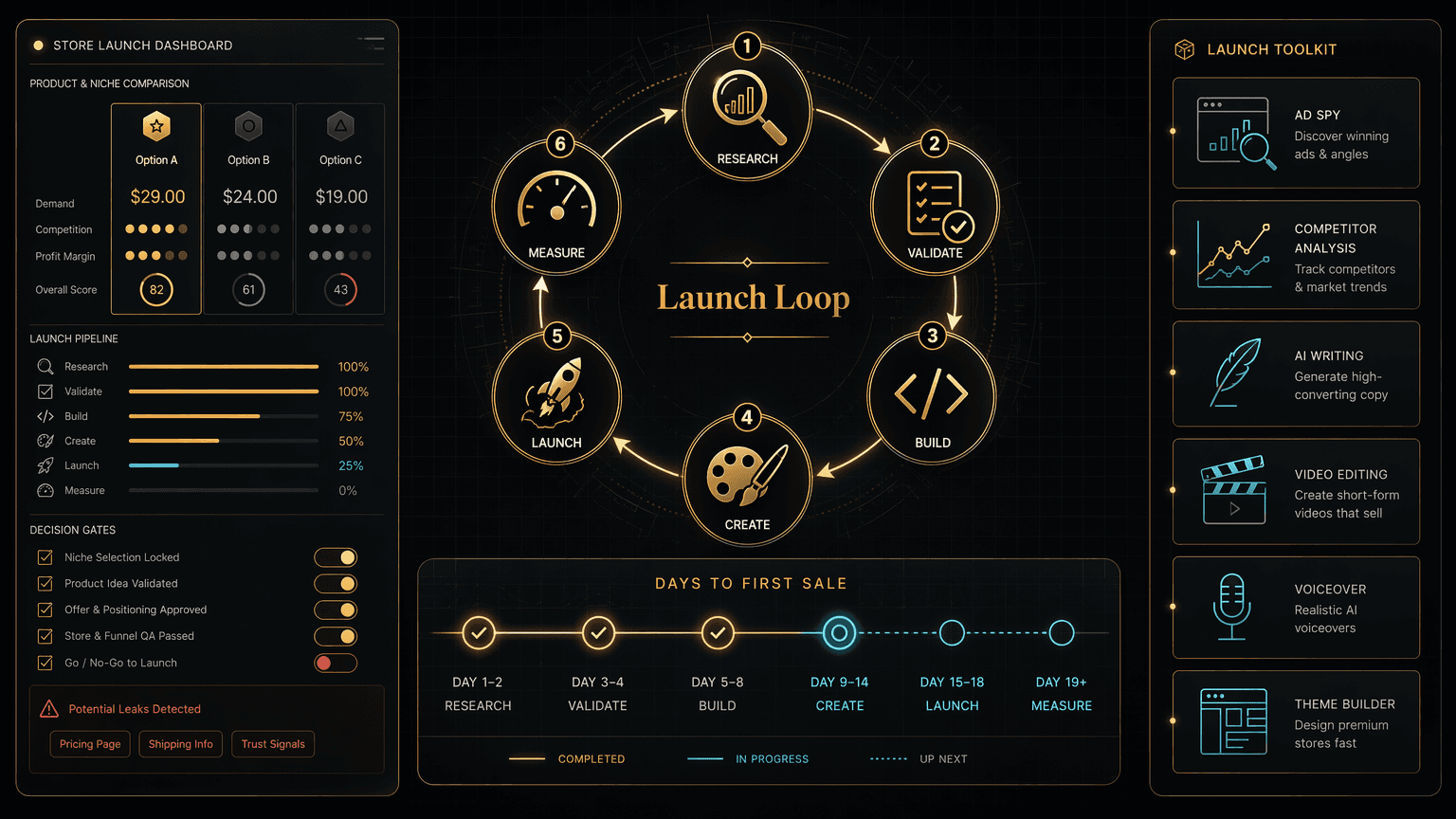
Launch first and optimize later is how stores die. Here is the sequenced research to measure loop, with the exact tool mapped to every stage.
Launch first and optimize later is how stores die. Here is the sequenced loop, with the exact tool mapped to every stage.
By Maxime Yao, research editor | Published 2026-07-17
Most first stores are built backward. Someone picks a product on Friday, throws up a free theme on Saturday, runs ads on Sunday, and blames dropshipping by Wednesday. The tools were never the problem. The order of operations was.
Here is the lie: launch first, optimize later. Here is the fix: a sequenced research, validate, build, create, launch, measure loop where nothing downstream starts until the step before it passes. And here is the honest number to anchor expectations: with a validated product and creative ready, a disciplined operator can reach a first sale in a matter of days, not hours, and any timeline shorter than that is usually luck, not process. Treat days-to-first-sale as a directional benchmark, never a guarantee.
We will run one niche through the whole loop: a minimalist desk-organization store targeting remote workers.
TL;DR
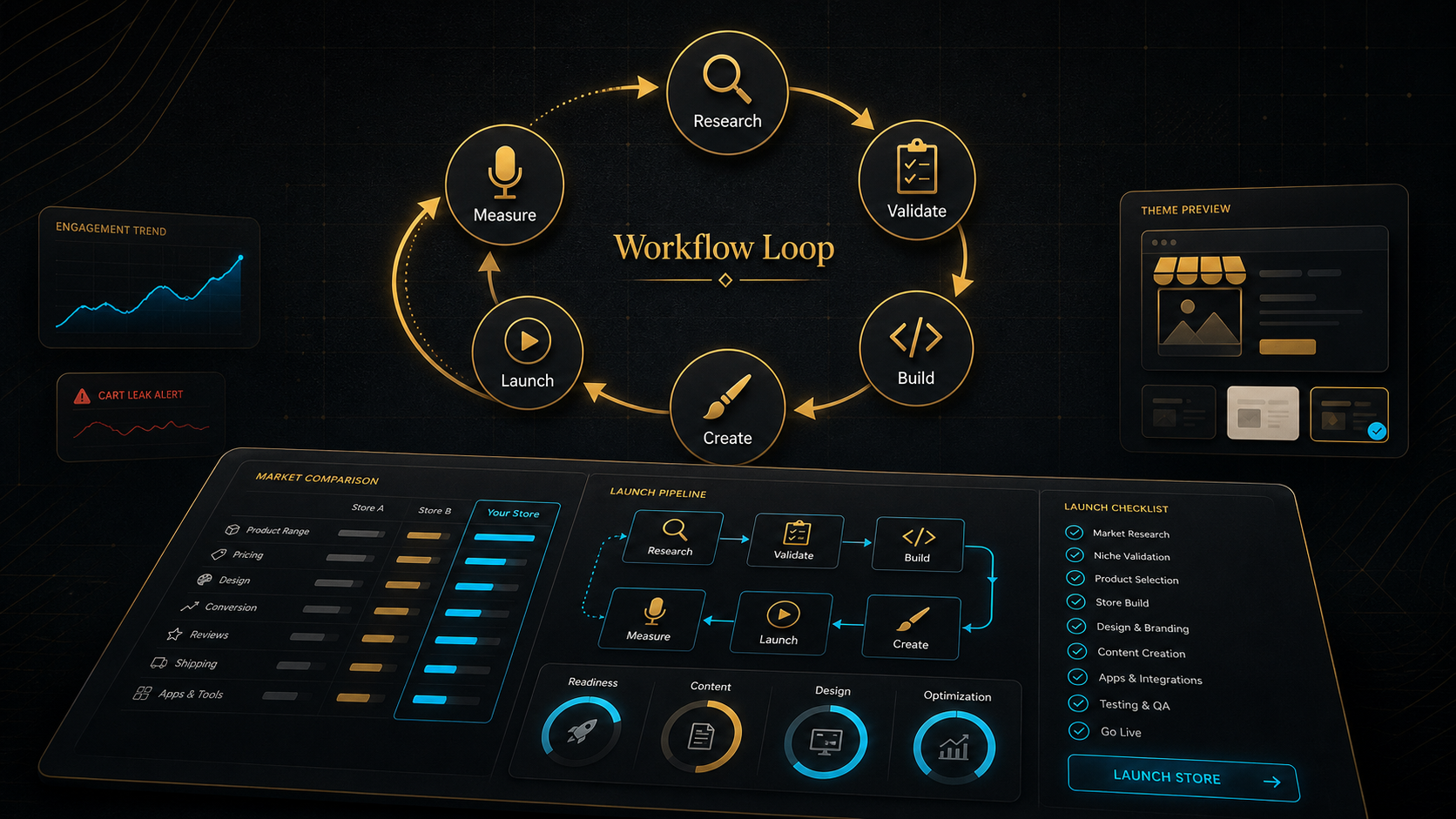
- Six stages: research, validate, build, create, launch, measure.
- Each stage has a gate. You do not advance until it passes.
- Every stage maps to a specific tool the bundle already covers.
- Days-to-first-sale is a directional benchmark, not a promise.
Stage 1: research
Goal: a shortlist of candidate products with a real demand signal. Tools: PipiAds and ShopHunter for ads and competitor storefronts, KaloData for TikTok Shop demand. You are looking for products with ads that have run for weeks and stores that look like real operations, not one-off tests.
Gate: at least three candidates with durable ad longevity. Desk niche: a cable-management tray and a monitor riser both show long-running ads. Advance.
Stage 2: validate
Goal: prove the shortlisted product survives scrutiny before you build anything. This is where you run the full product validation checklist: demand, margin, differentiation, supplier, shipping, ad angle, compliance. Skipping this stage is the single most common launch mistake.
Gate: the product clears all seven checks, with projected ad cost under about 30% of revenue. Desk niche: the cable tray passes, the riser fails on margin, so the tray moves forward alone. Advance.
Stage 3: build
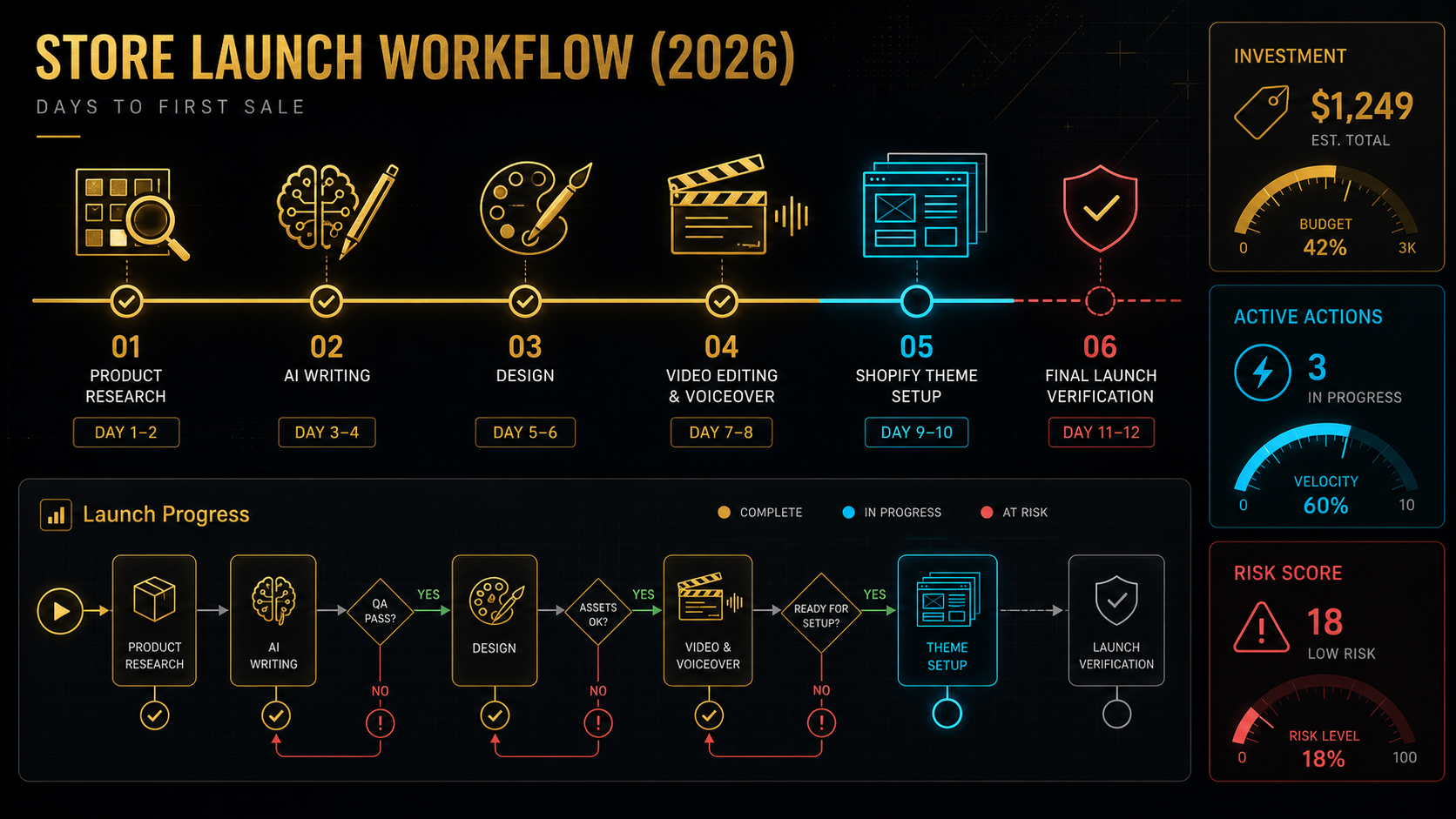
Goal: a clean, fast, mobile-first store. Tool: one of the 140+ Shopify themes in the bundle, so you are not stacking a free theme with five separate paid apps that slow the page and stack monthly fees. Most traffic is mobile, so a mobile-first, fast-loading theme is not a nicety, it is the conversion foundation.
Gate: product page loads fast on mobile, has clear value, price, shipping, and trust elements. Desk niche: a clean theme, one hero product, a tight bundle offer. Advance.
Stage 4: create
Goal: test-ready ad creative. Tools: ChatGPT Plus or Claude Pro for scripts, Canva Pro for frames, CapCut Pro for the edit, ElevenLabs for voiceover. The full step-by-step is in the AI creative workflow. Batch several variants so launch has something to test, not a single creative you have to bet everything on.
Gate: multiple distinct ad variants ready, each with a real hook in the first three seconds. Desk niche: five hook variants on the cable-tray demo. Advance.
Stage 5: launch
Goal: get the offer in front of the right audience with a controlled budget. Set a daily spend cap and a CPA ceiling derived from your margin math before you spend a cent. Launch is a test, not a coronation. You are buying data.
Gate: campaigns live, budget capped, tracking confirmed. Desk niche: variants launched with a firm CPA ceiling under the margin line. Advance.
Stage 6: measure
Goal: read the numbers that actually decide survival, not the vanity ones. This is where revenue lies to you and contribution margin tells the truth. Track CAC, ROAS against your breakeven ROAS, AOV, conversion rate, and refund rate, all defined in the ecommerce analytics metrics glossary. Kill losing variants fast, scale the winner slowly, and feed what you learn back into stage 1.
Gate: a variant hits CPA under your ceiling with positive contribution. Desk niche: two variants lose, one clears the line, so you scale that one and cut the rest. Loop closes.
Why it is a loop, not a line
The measure stage feeds the research stage. Winners teach you what your audience responds to, which sharpens the next round of research. Losers teach you where your validation was too loose. Operators who treat launch as a one-shot event learn nothing when it fails. Operators who treat it as a loop compound every attempt.
| Stage | Tool | Gate to advance |
|---|---|---|
| Research | PipiAds, ShopHunter, KaloData | 3+ candidates with durable demand |
| Validate | Validation checklist | Passes all seven gates |
| Build | 140+ Shopify themes | Fast mobile page, clear offer |
| Create | ChatGPT, Canva, CapCut, ElevenLabs | Multiple variants, strong hooks |
| Launch | Ad platform, capped budget | Live, capped, tracked |
| Measure | Analytics | A variant clears the CPA ceiling |
Where a bundle helps, and where it does not
The appeal of a bundled stack here is obvious: every stage already has its tool paid for under one subscription, so you are not assembling and billing eight tools to run one loop. If you want to test that stack cheaply, start on the Ecom Tools Pro plan and validate the fit first. The honest counterpoint: a bundle uses shared access, so for any tool you consider mission-critical, keep a direct account. That tradeoff is covered in the group-buy licensing and account-risk guide.
The honest caveats
- A clean workflow raises your odds, it does not guarantee a sale. Product-market fit, budget, and timing still decide the outcome.
- Days-to-first-sale varies widely. Do not treat any timeline as promised.
- You need a real ad budget to run stages 5 and 6. This is not a no-money method.
A realistic first-launch timeline
Speed is not the goal, sequence is. But operators still want a sense of pace, so here is a realistic shape for a first disciplined launch. Treat every number as directional, not promised, because product, budget, and market all move it.
| Days | Stage | What done looks like |
|---|---|---|
| 1 to 2 | Research | Three-plus candidates with durable ad longevity |
| 2 to 3 | Validate | One product clears all seven gates |
| 3 to 4 | Build | Fast mobile store, one hero offer live |
| 4 to 6 | Create | Several ad variants with strong hooks |
| 6 to 7 | Launch | Campaigns live, budget capped, tracking on |
| 7 onward | Measure | Read CPA against your ceiling, cut and scale |
Notice what this timeline refuses to do: it never lets building start before validation finishes. The operator who launches in two hours skips straight to build, and pays for it in the measure stage that never arrives because the product was never viable. A week of sequence beats a weekend of guessing.
The three ways this loop breaks
Even a well-sequenced loop fails when one of three things goes wrong. Know them before they cost you.
- You let a stage advance without passing its gate. The most common failure. A product that half-passes validation, a store that is slow on mobile, a single creative instead of several. Each weak handoff compounds downstream. The gate exists precisely so you stop and fix it before it multiplies.
- You read vanity metrics in the measure stage. Rising revenue with rising losses is the classic trap. If you watch total sales instead of cost per acquisition and contribution margin, you scale a losing campaign and call it growth. The metrics glossary exists to keep you honest here.
- You never close the loop back to research. Treating launch as a one-shot event wastes the most valuable output of the whole process: what the market just taught you. Winners reveal the angle your audience responds to, losers reveal where validation was loose. Feed both back into the next round or you relearn the same lessons at full price.
The stage details beginners underrate
Two stages quietly decide more than operators expect. The first is build. A store that loads slowly on mobile leaks conversions before a single ad is judged, and since the large majority of ecommerce traffic is mobile, a slow theme is not a cosmetic problem, it is a math problem. Using one integrated theme rather than a free theme plus five separate apps keeps the page fast and the monthly bill single, which is a large part of why a bundled stack suits a first launch.
The second is create. A single creative is a single bet, and single bets lose. The operators who win batch many variants, launch them together, kill the losers fast, and pour budget into the one that clears the line. That is only affordable in time when the whole creative stack, script, design, edit, and voice, sits in one place, which is the case the AI creative workflow makes in detail. The research that starts the loop leans on the same logic: fast, broad access to the tools that surface demand, which is exactly what a group-buy bundle provides, and what you can test on the Pro plan before committing. Whether a bundle or direct subscriptions serve you better comes down to the honest calculation in real SaaS savings.
Budgeting the launch before you spend
The measure stage only works if you decide the rules before emotion enters the room, and that means setting your budget and your kill criteria in advance. Before a single ad runs, write down two numbers: the daily spend cap you can afford to lose while gathering data, and the cost per acquisition ceiling above which the product is not viable. The ceiling comes straight from your margin math, not from hope. If your contribution margin allows a CPA of ten dollars, then a campaign consistently delivering fifteen is not a campaign that needs more time, it is a campaign telling you the truth. Operators lose money not because they test, but because they refuse to honor the ceiling they set, pouring more budget into a losing variant in the belief that the next day will be different. Discipline in this stage is worth more than cleverness in any other. Decide the numbers cold, then let the data enforce them.
It also helps to separate the cost of learning from the cost of scaling. The first phase of a launch is not meant to be profitable, it is meant to buy information: which hook works, which audience responds, what the real CPA is. Budget that phase as tuition. Once a variant clears your ceiling with positive contribution, the second phase begins, and here the rule flips from learn fast to scale slow. Increasing budget too quickly on a working variant frequently breaks the very economics that made it work, because the ad platform reaches further into a less responsive audience and your CPA climbs. Step the budget up in measured increments and watch the cost per acquisition at each level, backing off the moment it crosses your line. This is the unglamorous core of the whole loop, and it is where most of the money is actually made or lost.
What a first sale actually teaches you
A first sale is not a finish line, it is a data point, and its real value is what it tells you to do next. It confirms the funnel works end to end: the ad stopped someone, the page convinced them, the checkout completed. That is genuinely worth celebrating, but the operator who treats it as proof of a business is the same one who scales too fast and breaks the economics. Read the first sale as the moment the loop earns the right to repeat, then immediately ask the harder questions. Which variant produced it. At what cost. Whether that cost leaves contribution after every deduction. The answers feed straight back into the research stage, sharpening the next round, which is why this is drawn as a loop and not a ladder. The operators who compound are the ones who extract every lesson from each launch and carry it forward, so that the tenth attempt is standing on the shoulders of the first nine rather than starting from zero every time.
The hidden cost of a scattered stack
There is a practical reason the loop is easier to run from one place, and it is not just the monthly bill. A scattered stack of separately purchased tools imposes a tax that never shows on any invoice: the friction of remembering eight logins, tracking eight renewal dates, reconciling eight charges, and context-switching between eight interfaces that were never designed to work together. Each of those is small on its own, and together they are exactly the kind of drag that stops a first-time operator from ever completing a full loop. The store that dies is rarely killed by a single bad decision. It is killed by a hundred small frictions that add up until the operator quietly stops, and a fragmented tool stack is a reliable source of that friction. Consolidating research, creative, and build tools under one subscription removes a category of decisions entirely, which is worth more to a beginner than any single feature, because the scarcest resource in a first launch is not money or tools, it is the attention and momentum to actually finish. That is the honest case for a bundled stack at this stage, and it is why the loop above assumes one. It is also why the reverse warning matters: if a specific tool becomes central to how you make money, move it to a direct account so a shared-access hiccup can never stall your whole operation. The right structure early is a bundle for breadth and momentum, graduating to direct accounts for the two or three tools that eventually carry the business.
FAQ
Can I skip validation if the product is clearly trending?
No. Trending is a demand signal, not a profit signal. The validation stage is precisely where trending products reveal whether the margin closes.
Do I need all the creative tools?
You need a way to script, design, edit, and voice. The named tools cover each step, but the workflow matters more than any single tool.
How much budget do I need to launch?
Enough to gather statistically meaningful data at your target CPA. Set the daily cap and CPA ceiling from your margin math before launch.
What is the first metric to watch after launch?
Cost per acquisition against your breakeven line, then contribution margin. Revenue alone can rise while you lose money on every order.
How fast should I scale a winner?
Slowly. Scaling too fast often breaks the economics that made the variant work. Increase budget in steps and watch CPA at each level.
The one-line decision filter
If you are tempted to build before you validate, stop and run the loop in order. Research, validate, build, create, launch, measure, then feed the result back into research and go again. The operators who win are not the ones who launch fastest, they are the ones who run this loop cleanly, honor every gate, and let each attempt teach the next.