Red flags in ecommerce tool bundles: 8 to check first
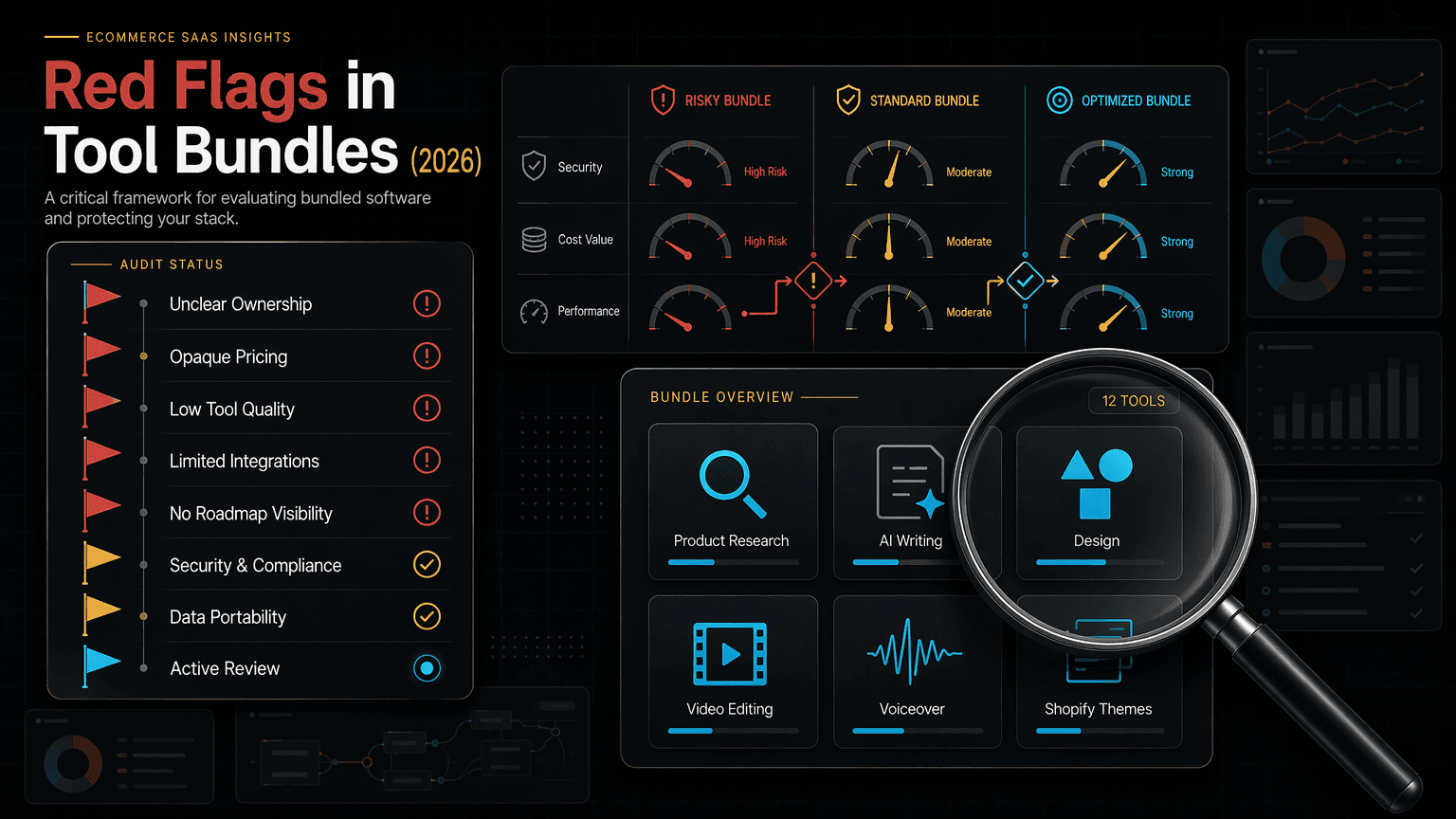
More tools is not a better deal. Here are 8 red flags to check before you subscribe to any ecommerce tool bundle, and how to verify each one in minutes.
More tools is not a better deal. Before you subscribe to any ecommerce tool bundle, run it through eight red flags. Each one takes about a minute to check, and each one has sunk a buyer who skipped it.
By Maxime Yao, research editor | Published 2026-07-17
You land on the sales page. A number hits you first: 25 tools. 40 tools. 50-plus premium tools, one low price. A countdown clock ticks in the corner. Five-star reviews scroll past with smiling faces. A live counter says 1,342 members joined this week. It feels like a steal, so you reach for your card.
Stop. Count what you can actually verify. Not what the page claims. What a stranger could confirm in a new browser tab. For most bundle pages, the honest answer is almost nothing, and the gap between the claim and the check is exactly where your money goes to die. The tool count is padded. The faces are stock. The counter is a script. And the flat monthly price that looked too good to be true often is, because someone else's stolen card is paying for the access you just rented.
This is not an argument against bundles. A good group-buy bundle can be the sharpest line on your stack. It is an argument against buying one blind. The bundles that burn people are not hard to spot once you know the eight things to look at, and the whole check fits in the time it takes your coffee to cool.
TL;DR
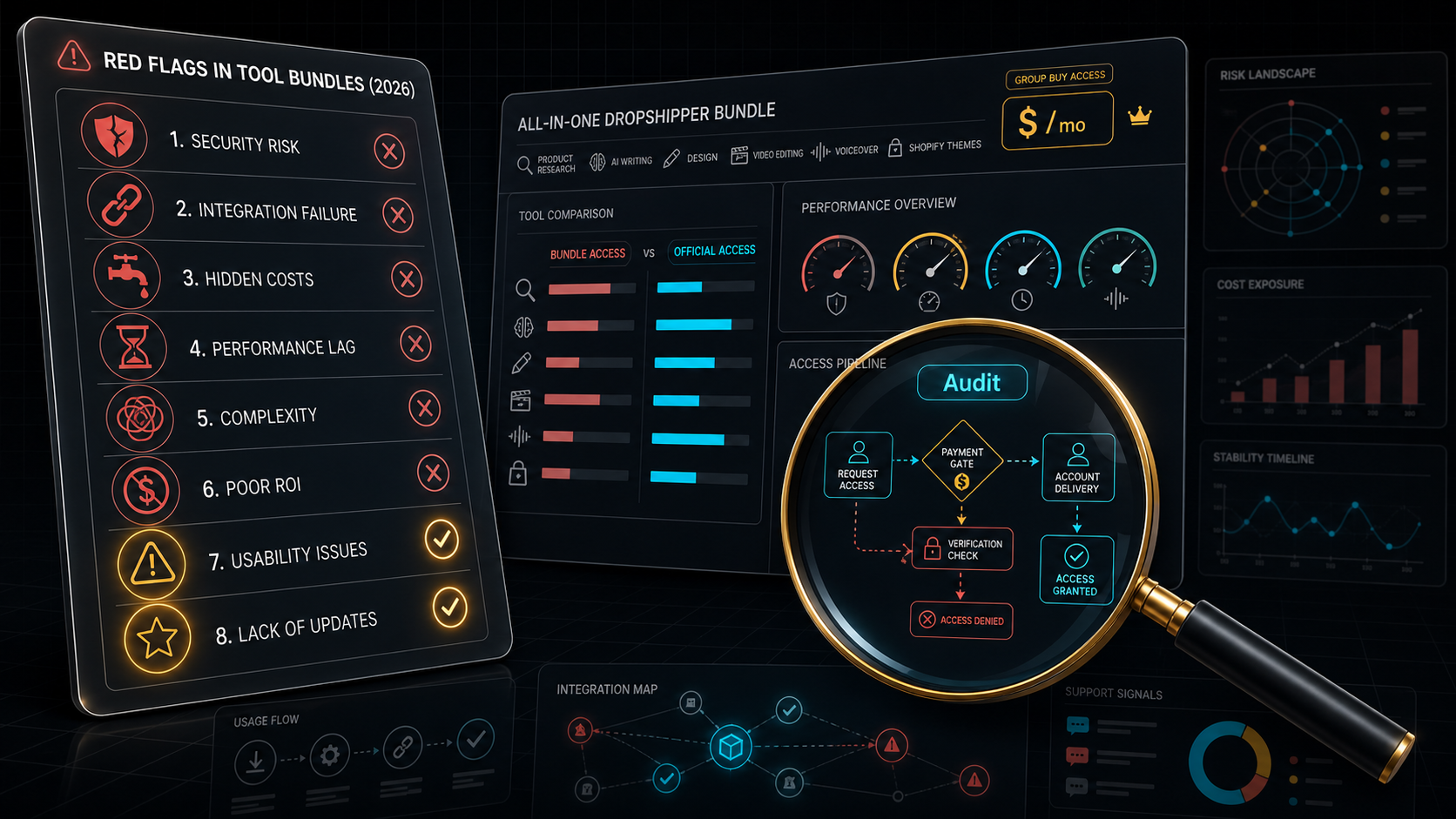
- The lie: more tools equals a better deal. It does not. A padded tool count is the single most common bundle trick, and the tools you will never open cost you nothing they can brag about.
- The fix: eight red flags to check before you subscribe to any ecommerce tool bundle, each verifiable in about a minute.
- The number: 8 flags. Zero cost to run. One skipped flag is how most bundle regret starts.
- The eight: inflated tool counts, fabricated testimonials, contradictory pricing and breakeven math, fake live stats, unverified social links, no clear refund policy, an anonymous operator with no accountability, and undisclosed shared-account licensing.
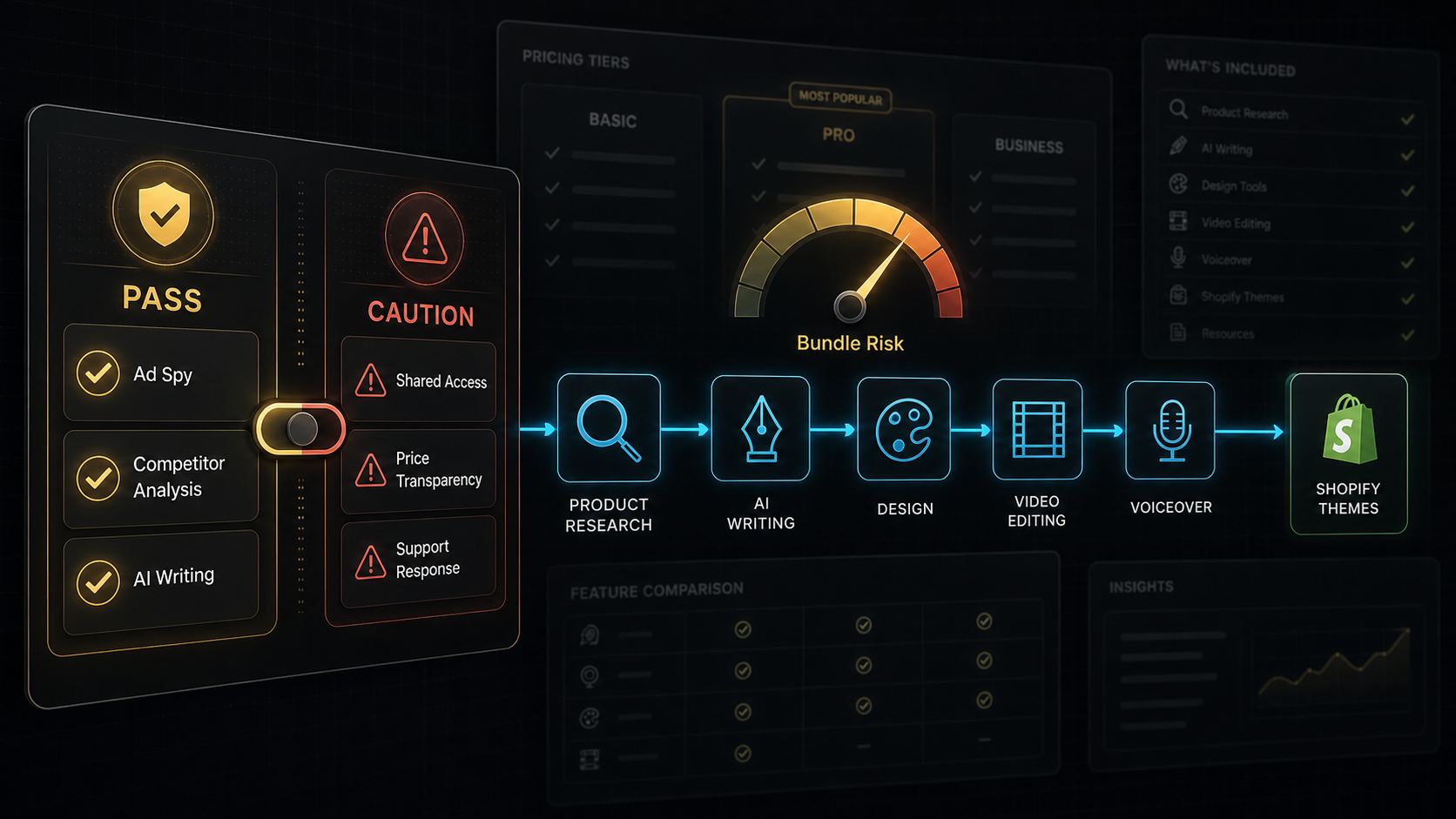
- The honest test: at the end, I hold Ecom Tools, the bundle this site covers, to the same eight flags. It passes on the ones that matter and carries three real cautions. The cautions are the point.
The lie: more tools equals a better deal
Here is the belief the whole industry is built to exploit: the bundle with the most tools is the best bundle. It feels obviously true. More stuff for the same money is more value. So the sales page leads with the biggest number it can defend, and often a bigger one it cannot.
The belief is wrong, and the reason is simple. Value is not the count of tools you can access. It is the count of tools you will actually use to ship work, minus the friction of getting to them. A bundle of 50 tools where you touch four is a four-tool bundle with 46 lines of decoration. Worse, the padding hides the thing you should be checking: are the four tools you need real, current, and reliably available, The big number is a magic trick. It points your eyes at quantity so you do not audit quality.
The counts are often inflated on purpose. A bundle claims 25 tools by counting a single AI subscription as three (the chat, the image feature, the voice feature), by listing tools that were removed months ago, or by padding with 140 free Shopify themes as if each theme were a premium seat. None of that is illegal. All of it is designed to make you stop counting and start paying.
The fix is not cynicism. It is a checklist. Run every bundle, including this one, through the same eight flags below. If a bundle clears them, the big tool number is a bonus. If it fails three, the number is bait. That is the whole discipline, and it settles in one figure: 8 flags, run before you subscribe, every time.
Flag 1: inflated tool counts
The headline number is the most padded thing on the page. Bundles inflate by triple-counting one subscription, by listing dead tools, and by folding free assets into a premium count.
How to check: ask for the current, dated, per-tool list. Not "50-plus tools." The actual names, today. Then cross-check the count against the operator's own listing on the marketplace where you pay. If the sales page says 25 and the checkout listing says 16, the sales page is padded by nine. Count the tools you would genuinely use. If that number is four, judge the bundle as a four-tool bundle at its price.
Why it matters: a padded count is the tell that the operator is selling perception, not access. And it hides staleness. A tool listed but quietly removed is a promise you paid for and will never collect. The honest bundles publish a live catalogue with an as-of date so you can audit it. The rest give you a round number and hope you never ask.
Flag 2: fabricated testimonials and personas
This is the biggest tell, and since 2024 it is also illegal. Scam pages fill a wall with glowing quotes attributed to "Verified Member, Dropshipping Operator" and a stock headshot. The faces are AI-generated or bought. The names are invented. The quotes were written by the person selling you the thing.
How to check: reverse-image search the profile photos. AI-rendered faces show unnatural hair edges and lighting that does not behave. Search the reviewer's name and handle. Do they exist off this one page, Then find the reviews on the platform where money changes hands, the marketplace listing, not the marketing site, because those are tied to real purchases and far harder to fake. Watch for quotes with no handle, no date, and a job title instead of a name. "Verified Member" is not a name.
Why it matters: in August 2024 the US Federal Trade Commission finalized a rule (16 CFR Part 465) banning fake and AI-generated reviews, testimonials from people who never used the product, and fake indicators of social media influence. It took full effect on October 21, 2024, and carries civil penalties the FTC has set at up to 51,744 dollars per violation, per the FTC's own announcement. A business willing to break that law to sell you a bundle is telling you exactly how it will treat you after you pay. Real reviews with real handles, tied to real purchases, are the only social proof worth anything.
Flag 3: contradictory pricing and breakeven claims
Bundles love a breakeven line. "Pays for itself in under 3 months." "Replaces 2,000 dollars of software." The trick is that the math rarely survives contact with a calculator, and different sections of the same site often give different numbers.
How to check: do the arithmetic yourself. If a lifetime plan is 499 dollars and the monthly is 30 dollars, the lifetime pays back against the monthly in about 17 months, not three. "Under 3 months" only works if you compare it to an inflated do-it-yourself stack total, and if that total is itself padded, the whole claim collapses. Check whether the "tools you would otherwise buy" are priced at real retail. As of this writing, PipiAds starts at 49 dollars a month on its Basic plan, Canva Pro runs around 18 dollars a month, and ChatGPT Plus is 20 dollars a month, per each vendor's pricing page (illustrative, verify current pricing). If a page sums those honestly, good. If it inflates each line to fatten the "you save" number, the breakeven is fiction.
Why it matters: when three sections of one site give three different breakeven numbers, none of them was calculated. They were chosen to sell. A number picked to persuade is worth nothing, and a business that will fudge the math on the price will fudge it on the value too. Make them show the work. For the honest version of this arithmetic, see how to calculate your real SaaS savings on a tool bundle.
Flag 4: fake live stats
The animated counter. "1,342 joined this week." A weekly usage chart with bars that jitter. A "live" activity feed of purchases scrolling up the corner. Most of it is a script with hard-coded numbers, running whether or not a single human showed up.
How to check: refresh the page. Does the countdown reset to the same starting time, Fake. Does the "joined this week" number tick up while you sit still, Script. Cross-check any "members" or "reviews" figure against the real count on the payment platform's listing. If the site says 1,100 members and the marketplace says 7,887, the site is not just lying, it is lying against its own interest, which tells you the number was never wired to anything real. Open the browser tools and watch: a real stat pulls from an endpoint, a fake one is baked into the page.
Why it matters: a fabricated live counter is a lie you can catch in two seconds, which makes it a gift. If they will fake the easy, checkable number, assume they faked the hard, uncheckable ones too. And the FTC rule from Flag 2 covers fake indicators of social media influence as well, so invented "live" social proof is not just tacky, it is in scope.
Flag 5: unverified social links
The footer shows the full set: X, YouTube, Instagram, TikTok. It looks like a real brand with a real presence. Then you click, and the link goes to a homepage, a dead account, an empty profile, or a handle squatted by someone else entirely.
How to check: click every social icon. All of them. A legitimate operator has active, engaged accounts you can scroll. A scam or a lazy reseller has icons that lead nowhere, to profiles created last month, or to an account that is clearly not theirs. Check the account age and the last post. An "official" channel with three posts from a fortnight ago and no engagement is a placeholder, not a presence.
Why it matters: per ScamAdviser's guidance, fake or empty social presence is one of the ten most reliable scam signals, because scammers are too rushed or too strategic to build real accounts. Dead social links also mean there is no public square where unhappy customers can shout, which is convenient for an operator who plans to disappoint them. And a squatted handle can send your traffic, and your trust, to the wrong brand.
Flag 6: no clear refund policy
Scroll to the footer and look for the exit. Can you find, in plain words, how to cancel and whether you can get your money back, On predatory bundles that information is missing, buried in legalese, or replaced with a weasel line like "review our policy at checkout."
How to check: before you pay, locate the refund and cancellation terms and read them. If the only mention of refunds is a vague pointer to some other page, treat the terms as unknown, and price the risk accordingly. Check the payment platform's own policy too, since a marketplace often sets refund rules the operator cannot override. Never take "contact support to cancel" as an answer. One-click cancellation is the sign of a business that is not afraid to let you leave.
Why it matters: hard-to-cancel, hard-to-refund terms are the hallmark of churn-and-burn subscription products that make their money by locking you in and betting you forget. Legitimate tools make leaving easy because they win when you stay by choice. And when the refund path is unclear, your real protection is the payment method: buy with a credit card or a platform that offers buyer protection, never a wire transfer, crypto, or gift card, so a chargeback is on the table if it comes to that.
Flag 7: an anonymous operator with no accountability
Who runs this, On a lot of bundle pages, nobody you can name. No founder, no bio, no company entity, no legal address. Just a brand mark and a checkout button. For a product that charges your card every month, that is a crater where accountability should be.
How to check: look for a real human or a real entity. A first name from reviews is thin but something. A founder bio, a LinkedIn, a registered business name is better. Read the footer copyright: does it name a legal entity, or just a brand and a year, Search the operator's name plus "scam" and "reddit" and read what surfaces off their own property. Total anonymity is not automatically fraud, plenty of solo operators stay private, but it removes every lever you would use if things went wrong.
Why it matters: the FTC and security researchers both note that fully anonymous fronts are far more common among scams than among real software companies, because a fake identity is how the operator plans to walk away clean. Anonymity is not proof of a scam. It is the removal of your recourse, and you should price that in. A semi-anonymous operator with a long, verifiable track record on a payment platform is a different animal from a nameless page that appeared last month.
Flag 8: undisclosed shared-account licensing
This is the one buyers understand least, and it is the one that decides whether the bundle is safe for your business. Most tool bundles at these prices are group-buy, shared-credential access. The operator holds the paid accounts and shares access, usually through a members channel. That model is exactly what makes 30 dollars a month for a stack of premium tools possible. It is also a dependency you are taking on, and a good operator says so plainly. A bad one hides it and lets you assume you are getting your own accounts.
How to check: find out, before you buy, whether you get your own vendor login or shared access to the operator's accounts. If the page never says, assume shared and ask directly. Ask how access is delivered, what happens when a vendor detects and bans a shared account, and whether your data is visible to other users of the same login.
Why it matters: shared access carries real, documented risks. Independent SEO consultants and security writers warn that some group-buy operators fund their accounts with stolen credit cards, which get cancelled and take your access down with them. Shared logins violate most tools' terms of service, so the vendor can ban the account, and independent analysis notes the contract risk sits mainly with the operator who signed the terms, not the end user, but you still lose access when the ban lands. And anything you type into a shared account, client domains, product research, keyword lists, can in principle be visible to strangers on the same login. None of this makes group-buy illegitimate. It makes disclosure non-negotiable. An operator who owns the shared-access model up front is being honest about the trade. One who hides it is selling you a risk you did not agree to. Read the full version in the group-buy tool licensing and account-risk guide.
The red-flag checklist, at a glance
Copy this. Run it on every bundle before you subscribe, including the one you are already leaning toward. The whole pass takes a few minutes.
| # | Red flag | How to check in ~60 seconds | Why it matters |
|---|---|---|---|
| 1 | Inflated tool count | Ask for a dated per-tool list; compare to the checkout listing; count tools you would actually use | Padding hides stale or removed tools and sells perception, not access |
| 2 | Fabricated testimonials | Reverse-image the faces; search names; read reviews on the payment platform, not the marketing site | Fake reviews are illegal under the 2024 FTC rule; a liar here lies everywhere |
| 3 | Contradictory pricing / breakeven | Do the arithmetic; price the DIY stack at real retail; look for conflicting breakeven numbers | A number chosen to persuade was never calculated, and hides the real cost |
| 4 | Fake live stats | Refresh the page; watch counters reset or tick; cross-check against the platform's real numbers | An easy lie you can catch signals the hard lies you cannot |
| 5 | Unverified social links | Click every icon; check account age, last post, and whether it is really theirs | Dead or squatted socials mean no public accountability and misdirected trust |
| 6 | No clear refund policy | Find and read the cancel and refund terms before paying; check the platform's policy too | Hard-to-leave terms are the churn-and-burn signature; pay with buyer protection |
| 7 | Anonymous operator | Look for a named human or legal entity; read the footer; search name + "scam" + "reddit" | Anonymity removes every lever you would need if things go wrong |
| 8 | Undisclosed shared access | Confirm whether you get your own login or shared credentials; ask how access is delivered | Shared access has real ban, funding, and privacy risks; hiding it hides the trade |
The honest test: holding Ecom Tools to its own eight flags
This site covers Ecom Tools, a group-buy ecommerce bundle. It would be gutless to publish an eight-flag checklist and then exempt the product we link to. So here is Ecom Tools run through the same eight, straight, including where it should give you pause.
First, where it passes, and passes cleanly. The social proof is real and checkable on the Whop listing, not invented on a marketing page. Ecom Tools shows 7,887 joined on Whop, a 4.8-star rating from 182 verified reviews, and a 94 percent five-star share. The reviews carry real handles and real sentences, not stock faces and job titles:
"The variety of tools available here on ecom-tools is unbelievable & no other tool provider is giving such fine services & customer support" - Zain Khan (@zain60912), from Whop reviews
"Great selection of tools and fastest support I have ever seen" - Somira (@somiraa), from Whop reviews
"Very convenient and helpful, they got the best and fastest support" - Milad Massalha (@massalha), from Whop reviews
Those clear Flag 2 and Flag 4: real testimonials with handles, real numbers you can confirm on the payment platform. On pricing (Flag 3), the plans are plain and checkable: 29.99 dollars a month on Pro, 499 dollars one-time on Lifetime, with a free tier and a paid Pro plan. Do the Lifetime-versus-monthly math yourself and it pays back in roughly 17 months against the monthly plan, so treat any "breakeven in 3 months" claim you see anywhere with the skepticism Flag 3 demands, and confirm the current paid-plan details at checkout rather than trusting a marketing line.
Now the honest cautions, because this is where the trust is earned. Three flags land as amber, not green.
| Flag | Ecom Tools | Read |
|---|---|---|
| 2. Testimonials | Pass. Real Whop reviews, real handles (Zain Khan, Somira, Milad Massalha), 182 verified. | Green |
| 3. Pricing / breakeven | Pass, with a catch. Prices are clear; ignore any "3-month breakeven" line, the real figure is ~17 months vs monthly. | Green, verify the math |
| 4. Live stats | Pass on the source. The 7,887 / 4.8 / 182 figures are real on Whop. Trust the Whop listing, not any animated on-site counter. | Green, at the source |
| 1. Tool count | Caution. The operator's own Whop description says 16-plus tools; some marketing surfaces claim more. Verify the current per-tool list yourself before you judge the count. | Amber |
| 7. Anonymous operator | Caution. The operator is known only as "Rony" from reviews, semi-anonymous, on Whop since July 2023. A track record exists; a full identity does not. | Amber |
| 8. Shared-account licensing | Caution by design. It is a group-buy: one Whop subscription grants Discord-delivered shared access to the paid tools. That is the model, not a flaw, but it carries the shared-access risks in Flag 8. | Amber, disclosed |
Read the amber row honestly. Ecom Tools is a shared-credential group-buy run by a semi-anonymous operator, with a published tool count you should verify rather than take on faith. Those are real caveats, and I am not going to paper over them. What tips the balance toward worth-a-look rather than walk-away is that the accountability gap is filled by something checkable: 7,887 joined and 182 verified reviews at 4.8 stars on a payment platform that ties reviews to real purchases. A long, public, purchase-linked track record is not the same as a founder bio, but it is real recourse and real evidence, which is more than most anonymous bundle pages can show. Weigh it for yourself, and read the fuller judgment in the Ecom Tools 2026 review.
How to de-risk any bundle before you commit
Flags tell you what to avoid. Here is how to lower the cost of a yes once a bundle clears them.
- Run all eight flags first. Five minutes. If it fails three, you are done, no trial required.
- Start on the smallest paid tier or the free path. If a free tier exists, use it. Test the actual tools you need against your actual work before you commit to lifetime anything. Confirm the current paid-plan details at checkout.
- Verify the two or three tools you came for. Log in. Confirm they are current, functional, and not a stripped iframe. A bundle is worth only the tools you will really use.
- Keep your own account on anything mission-critical. Consolidate convenience tools into shared access. Never put the one tool your revenue cannot survive a day without onto someone else's login.
- Pay with buyer protection. Credit card or a platform with a refund path. Never wire, crypto, or gift card. Keep the chargeback lever in your hand.
That sequence turns "should I risk it" into "here is exactly how I test it," which is the only honest way to buy a shared-access product.
The verdict
More tools is not a better deal. The count is the most padded number on any bundle page, and chasing it is how buyers walk past the eight things that actually decide whether their money is safe. Run the flags. Every bundle, every time.
| Subscribe to a bundle if | Walk away if |
|---|---|
| The tool list is dated, specific, and mostly tools you will use | The count is a big round number with no current per-tool list |
| Reviews are real, handled, and on the payment platform | Testimonials are stock faces and job titles, not names |
| Pricing and breakeven math survive your own calculator | Three sections give three different breakeven numbers |
| The shared-access model is disclosed and you accept the trade | Nobody will tell you whether access is shared or your own |
| There is real recourse: a track record, a platform, buyer protection | Anonymous operator, dead socials, no refund path, untraceable payment |
Ecom Tools clears the flags that catch scams and carries three disclosed cautions: shared access, a semi-anonymous operator, and a tool count worth verifying. If you accept those trades with eyes open, the free tier and Pro plan are the low-risk way to test the fit against your own stack. Confirm the current paid-plan details at checkout, and review Whop's current refund policy at checkout before you commit. Start on the Ecom Tools Pro plan and run your own eight-flag check.
FAQ
What is the single biggest red flag in a tool bundle?
Fabricated testimonials, because they are both the most common trick and, since October 2024, illegal in the US under the FTC's fake-reviews rule (16 CFR Part 465), which carries penalties the FTC has set at up to 51,744 dollars per violation. Reverse-image the faces, search the names, and read reviews on the payment platform where purchases are verified, not on the marketing page where anything can be invented. A business willing to fake its reviews will fake everything else.
Are group-buy tool bundles a scam?
Not inherently. Group-buy means shared-credential access to paid tools for a flat fee, and plenty of operators run it honestly. The risks are real, though: independent writers document operators funding accounts with stolen cards, vendor bans on shared logins, and privacy exposure on a shared account. The scam is not the model, it is hiding the model. An operator who discloses shared access up front is being straight; one who lets you assume you get your own login is not. Judge disclosure, not the label.
How do I verify a bundle's tool count is real?
Ask for a current, dated, per-tool list by name, and cross-check the count against the operator's listing on the platform where you pay. If the sales page says 25 and the checkout says 16, the sales page is padded. Then ignore the total and count only the tools you would genuinely use. A 50-tool bundle where you touch four is a four-tool bundle. The number that matters is your number, not theirs.
Is a bundle with more tools always cheaper than buying separately?
Only for the tools you actually use. At real retail, a single ad-spy tool like PipiAds starts around 49 dollars a month, Canva Pro runs about 18 dollars a month, and ChatGPT Plus is 20 dollars a month (illustrative, verify current pricing). If your keepers overlap a bundle's catalogue, consolidation can genuinely undercut buying them one by one. If the bundle pads its "you save" number with tools you will never open or inflated retail prices, the saving is fiction. Do the math on your keepers, not their headline. See how to calculate your real SaaS savings.
What payment method protects me if a bundle turns out bad?
A credit card, or a platform with its own refund and dispute process. Both keep a chargeback available if access dies or the operator vanishes. Never pay a bundle by wire transfer, cryptocurrency, or gift card: those are irreversible, and a seller who pushes them is removing your only recourse on purpose. Locate the refund and cancellation terms before you pay, and if they are vague, price the risk as if refunds do not exist.
The filter is simple: if a bundle cannot survive an eight-flag check you run in five minutes, no tool count on its page is worth your card. Run the flags, verify the tools you came for, keep buyer protection in hand, and start small. If a bundle clears the flags and you accept its disclosed trades, start on the Ecom Tools Pro plan and test it against your own stack.