Ecom Tools alternatives 2026: an honest lane-by-lane map
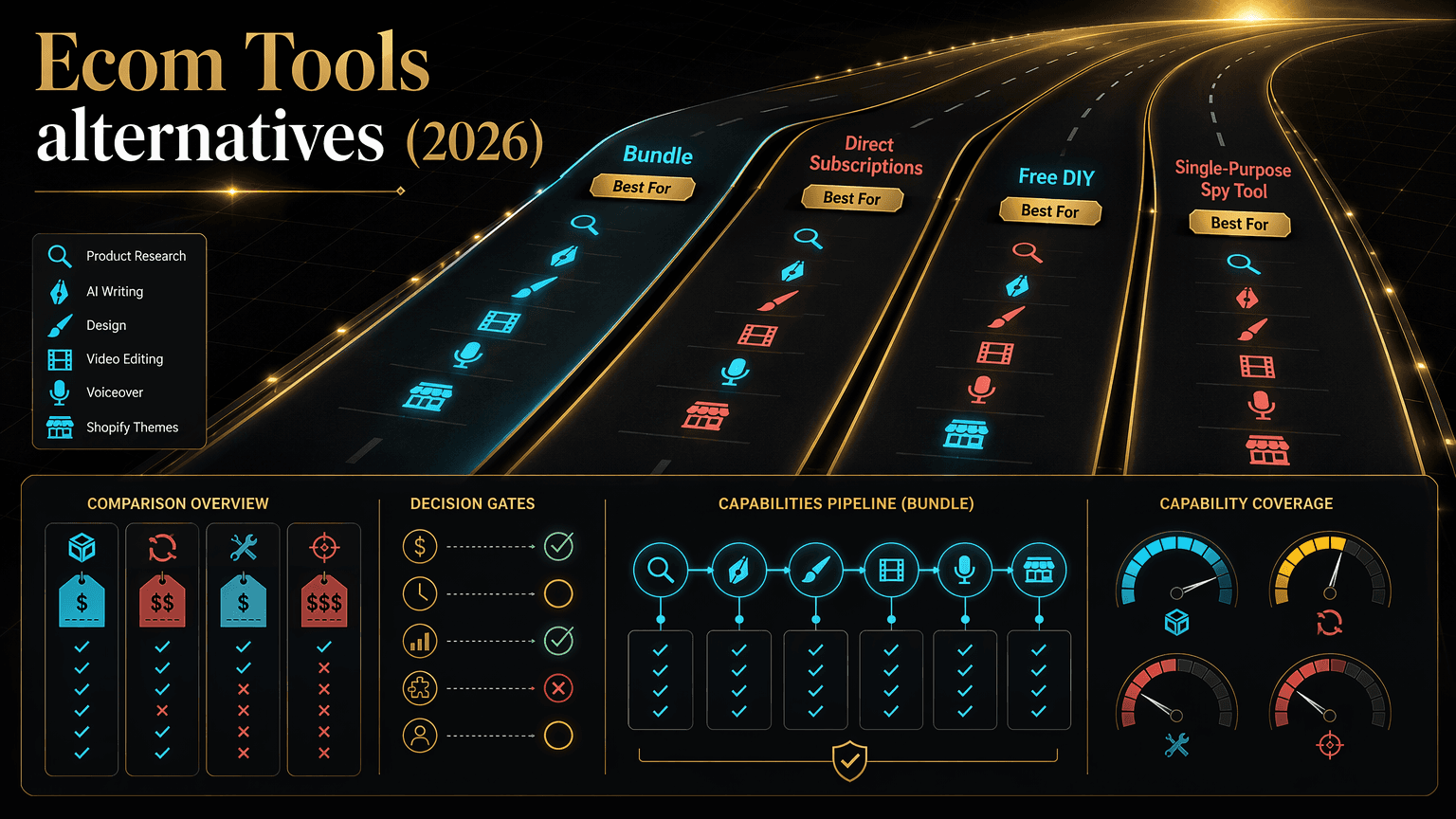
Ecom Tools alternatives in 2026, mapped by lane: other group-buy bundles, direct subscriptions, free DIY, and premium single-purpose tools. Where each one wins.
No single bundle wins every lane. Here is the honest map of your alternatives to Ecom Tools, and the one lane where a group-buy actually beats them all.
By Maxime Yao, research editor | Published 2026-07-17
You are hunting for the best deal, and somewhere in the search a tidy little belief has set in: there is one right stack, one bundle that beats everything, and if you just find it you can stop thinking. Buy the winner. Move on. That is the promise every tool bundle sells, Ecom Tools included, and it is the reason most buyers pick wrong. They shop for a champion when they should be shopping for a fit.
Here is the trap. Ecom Tools is a strong option in one specific lane, and a weak one in others. So is every alternative on this page. A free stack crushes the bundle on price and loses on depth. A premium spy tool crushes it on depth and loses on breadth. Another group-buy competes on the exact same terms. There is no universal winner. There is only the tool that fits what you are actually doing this month. This article draws the map, lane by lane, so you can find your own square instead of buying someone else's champion.
- The lie: one bundle wins every lane, so just find the best one and buy it.
- The fix: an honest lane-by-lane map. Four real routes, what each is best for, and the tradeoff each one hides.
- The four routes: other group-buy bundles (like ToolSuite), direct single subscriptions, the free and DIY stack (Google Trends, Canva Free, ChatGPT free tier, TikTok Creative Center), and premium single-purpose tools (AdSpy, Minea).
- Where Ecom Tools wins: breadth per dollar. 16+ tools for $29.99 a month is the widest cheap net on this page.
- Where it loses: depth, ownership, and support on any one tool your business truly leans on.
- The proof: 7,887 joined on Whop, 4.8 stars from 182 verified reviews, 92% five-star.
The lie: one bundle wins every lane
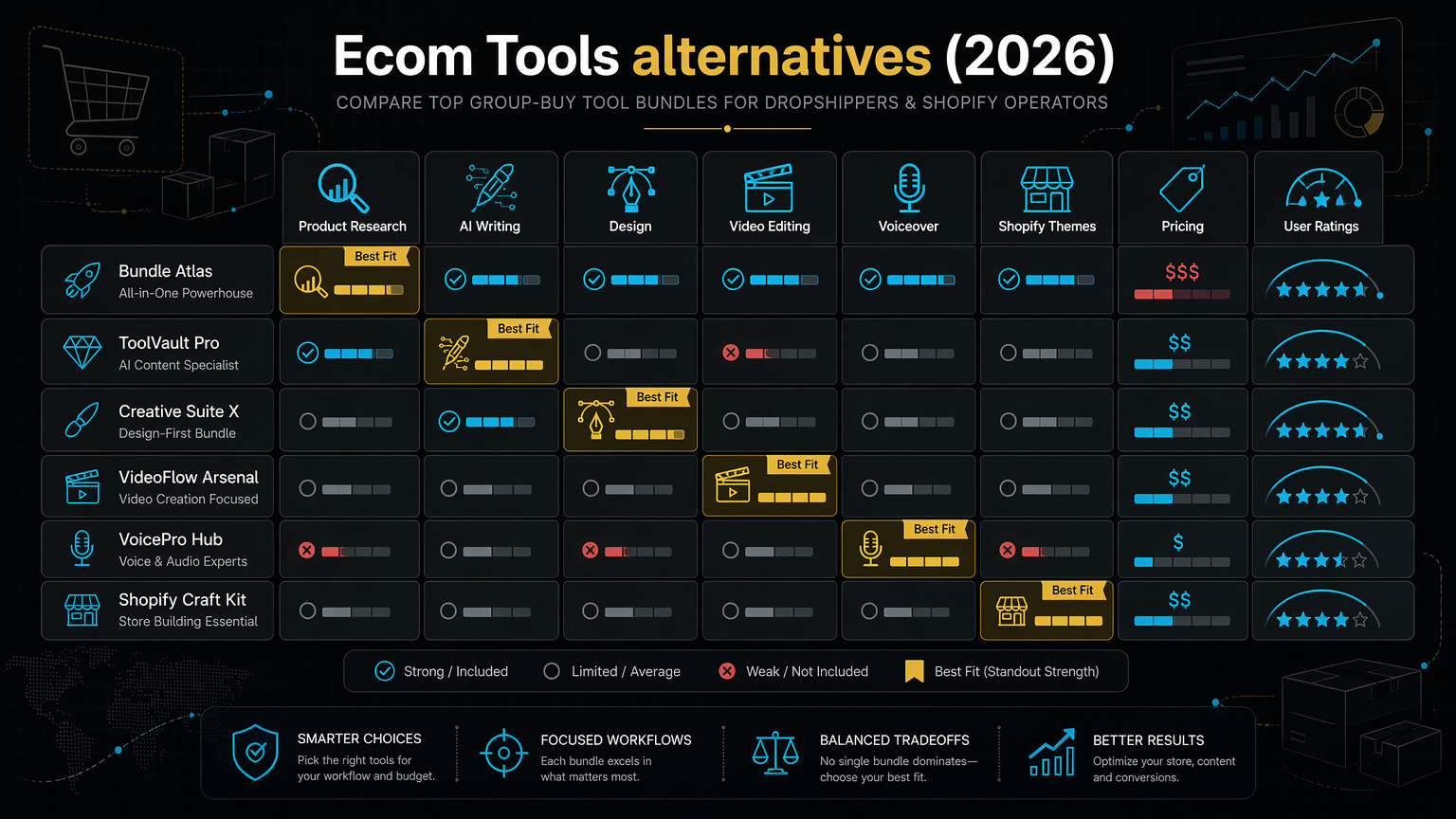
The belief is seductive because it saves you work. If one bundle is simply the best, you do not have to understand your own workflow, your own budget, or your own risk tolerance. You just buy the thing everyone rates highest and trust the crowd. Decision outsourced. Brain off.
But tools do not have a single ranking, because buyers do not have a single job. The beginner validating their first product and the agency running six client stores are not shopping in the same market, even when they type the same search. Price matters enormously to one and barely registers for the other. Ownership is a dealbreaker for one and irrelevant to the other. A tool that is perfect for a Tuesday-night side hustler is wrong for a paid-traffic operator, and neither of them is dumb. They are in different lanes.
So the question is never "what is the best tool bundle." That question has no answer, the same way "what is the best vehicle" has no answer until you say whether you are moving house or racing. The real question is "which lane am I in, and what wins there." Answer that and the choice makes itself. Skip it and you buy a champion built for someone else's race. The fix is a map, not a ranking. Here it is.
The four routes out of Ecom Tools
Every alternative to Ecom Tools falls into one of four routes. Each solves a different problem. Each charges a different price, in money or in effort or in risk. Read all four, then find the one that matches what you are actually doing, because the honest answer for most people is a blend, not a single door.
Route 1: another group-buy bundle
The nearest alternative is a rival bundle running the exact same model: one subscription, shared credentials delivered through Discord, a stack of paid tools for a flat monthly fee. The best-known sibling is ToolSuite, a separate Whop business operated by @scalecord. It is a different operator and a different codebase from Ecom Tools, but it competes for the identical buyer with an overlapping catalogue, including tools like PipiAds, KaloData, Canva Pro, ChatGPT and CapCut.
What this route is best for: someone who has already decided the group-buy model fits them and simply wants to compare two vendors of it. The tradeoff is that you are not escaping any of the group-buy strings by switching bundles. You still get shared access instead of ownership, the bundle operator instead of first-party vendor support, and the same grey-zone licensing risk. You are choosing between two rentals, not between renting and owning. So the comparison collapses to the boring, correct questions: whose current tool list actually contains the tools you came for, whose support is faster when a shared login breaks, and whose reviews are more credible. On that last point, Ecom Tools carries 182 verified reviews at 4.8 stars with 92% five-star, and its review surface leans on full sentences praising speed and support. Verify any rival's live catalogue and review quality yourself before you switch, because a bundle's tool list is a moving target as vendor deals shift.
Route 2: direct single subscriptions
The opposite of a bundle. You skip every reseller and buy each tool straight from its vendor, at the tier you choose, in your own name. This is the route the phrase "real operators own their stack" is pointing at.
What it is best for: the tool your business cannot afford to have pause. Buy direct and the account is yours, your data and history are private and portable, support comes from the vendor who built the tool, and there is zero licensing risk because you are a normal paying customer inside their terms. The tradeoff is money and sprawl. The same named tools inside a bundle, bought direct at entry tiers, run far higher than $29.99 a month once you total them, and you manage a separate invoice, login and renewal date for each one. As a directional illustration based on published retail prices, a solo operator's core stack might look like PipiAds around $49 a month, Canva Pro around $18, ChatGPT Plus $20, CapCut Pro around $19.99, ElevenLabs Creator around $22 and Claude Pro $20 (illustrative, based on published retail prices; verify current pricing). Add three or four of those and you are already well past the bundle's monthly fee for a fraction of the tools. Direct wins the tool you depend on. It loses badly on breadth. The full arithmetic is in the Ecom Tools versus buying separately breakdown, and the method for pricing any stack is in the SaaS savings calculator guide.
Route 3: the free and DIY stack
The route almost nobody prices honestly, because it feels like cheating. A surprising amount of real ecommerce work can be done on free tiers and free public tools, if you are willing to trade money for effort and accept thinner data.
The free stack, tool by tool:
- Google Trends is free, and for spotting whether a product's search interest is rising, seasonal or dying, it is genuinely useful. It will not show you ad creative or store revenue, but it answers the single most basic validation question at no cost.
- Canva Free covers a lot of design ground. You lose the Pro extras like background remover, the full premium asset library and brand kits, but for basic product images, simple ad graphics and social posts, the free tier ships real work.
- The ChatGPT free tier writes ad copy, product descriptions, email and research prompts. You get a capable model with usage limits and without the priority access, higher limits and newest-model perks of the paid Plus tier. For drafting, the free tier carries most beginners a long way.
- TikTok Creative Center is free and, for TikTok specifically, it is a quietly excellent product-research and ad-inspiration tool straight from the platform itself. Trending hashtags, top ads, trending products and songs, all free. For a TikTok-first seller it replaces a chunk of what paid spy tools charge for.
What this route is best for: the beginner with more time than money, and anyone validating an idea before spending a cent. The tradeoff is real and it is effort plus depth. Free tools are scattered, so you stitch the workflow together yourself across five tabs. The data is shallower: no deep historical ad libraries, no competitor revenue estimates, no bulk exports. And usage caps on free AI tiers will interrupt you at the worst moment. Free wins on price, absolutely and forever. It loses on assembled convenience and on the depth that separates a hunch from a validated decision. Ecom Tools' pitch against this route is not "our tools are free," it is "our tools are deeper and pre-assembled for the price of one paid subscription."
Route 4: premium single-purpose tools
The specialist route. Instead of breadth, you buy one best-in-class tool and go deep. These cost more than the entire bundle, and for the right buyer they earn it.
Two named examples, with prices attributed and flagged for verification because these vendors move often:
- AdSpy is a heavyweight Meta ad intelligence tool. Per 2026 third-party pricing trackers, it runs a single flat plan around $149 a month with no tiers and no annual discount (verify current pricing at the source). That is roughly five times the entire Ecom Tools bundle, for one tool. What you buy is depth: a very large searchable Facebook and Instagram ad database with deep filters, demographic data and comment search that a bundled spy tool does not match.
- Minea is a product-research and ad-spy platform with a free plan and paid tiers. Per 2026 pricing trackers, its Starter plan is around $49 a month and its popular Premium plan around $99 a month, covering Facebook, TikTok and Pinterest ad research (verify current pricing; annual billing and coupons can lower these). Again, more than the bundle, for a narrower, deeper job.
What this route is best for: the operator whose entire edge lives in one function, usually deep ad research on a specific platform, run at volume, weekly, as the core of the business. The tradeoff is obvious: you pay premium money for a narrow tool and get no breadth. AdSpy will not design your creative, write your copy, cut your video or research your TikTok Shop. It does one thing at a depth the bundle cannot touch, and it charges accordingly. For what deep ad data actually proves and where it stops, see what ad-spy data proves.
The lane-by-lane map
Here is every route in one table. Route, who it is best for, and the tradeoff it hides. This is the whole article compressed. Read your row.
| Route | Example | Rough price | Best for | The tradeoff it hides |
|---|---|---|---|---|
| Group-buy bundle | Ecom Tools | $29.99/mo | Breadth on a budget, testing many tools at once | Shared access, no ownership, operator support |
| Rival bundle | ToolSuite (@scalecord) | Verify at source | Comparing group-buy vendors | Same strings, just a different landlord |
| Direct subscriptions | Buy each tool direct | ~$18 to $50/mo each (illustrative) | The one tool you depend on | High total cost, invoice and login sprawl |
| Free and DIY | Google Trends, Canva Free, ChatGPT free, TikTok Creative Center | $0 | Beginners, pre-spend validation | More effort, shallower data, usage caps |
| Premium single-purpose | AdSpy, Minea | ~$49 to $149/mo (verify) | One deep function run at volume | Premium price, zero breadth |
Notice what the table refuses to do. It will not crown a winner. Every route owns a column and loses another. That is not fence-sitting, it is the actual shape of the market. The buyer who wants a champion has to first admit which column they are shopping in.
Where Ecom Tools wins: breadth per dollar
Now the honest case for the bundle, made in one lane only, because that is the only lane it wins.
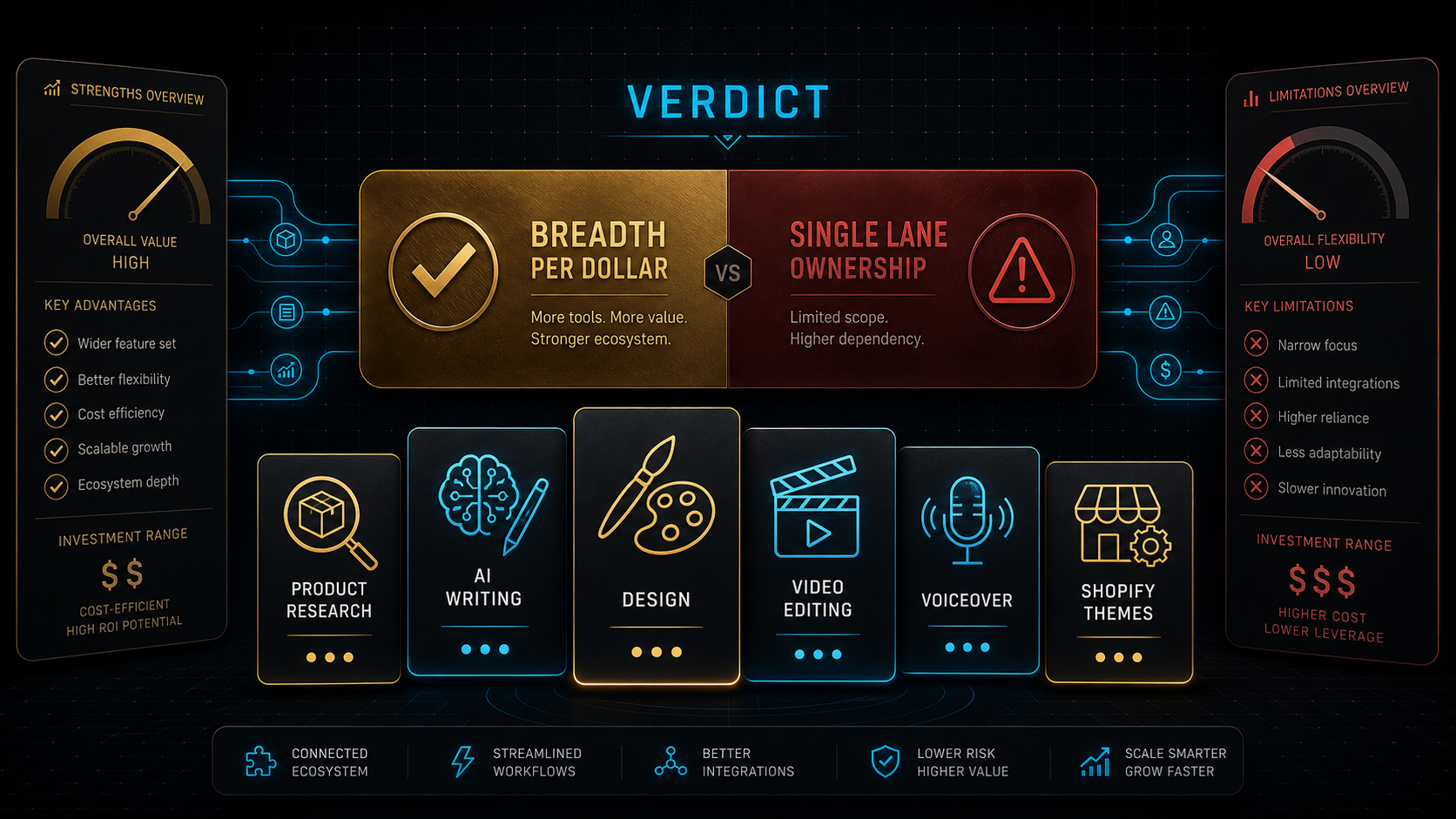
Ecom Tools wins on breadth per dollar, and it is not close. For $29.99 a month you get shared access to 16+ tools spanning product research, ad spy, AI writing, design and video editing, plus 140+ Shopify themes. No other route on this page gives you that many tool categories for that little money. A single premium tool like AdSpy costs five times as much and does one job. Buying the equivalent stack direct runs many times the price. The free stack matches it on money but not on depth or assembly. If your problem is "I need to touch many tool categories this month and I cannot justify hundreds in subscriptions," the bundle is the correct answer, and the alternatives are worse for that specific job.
This is also why the bundle is the strongest first move for a beginner or an experimenter. Its whole value is a cheap, wide net. You open every tool, learn which two or three you actually reach for, and only then decide whether any of them deserves a direct subscription. Spending $29.99 to find that out beats spending $245 to guess. The reviews back the experience within that lane: 7,887 joined, 4.8 stars from 182 verified reviews, 92% five-star, with the recurring praise landing on tool variety and support speed.
"The variety of tools available here on ecom-tools is unbelievable & no other tool provider is giving such fine services & customer support" Zain Khan (@zain60912)
"Great selection of tools and fastest support I have ever seen" Somira (@somiraa)
Treat those as evidence from the Whop review page, not promises. Note what they praise: variety and support, which are precisely the two things the breadth lane is supposed to deliver. For the full catalogue argument, see what is included in Ecom Tools.
Where Ecom Tools loses
The honest other half, because a review that only names the win is an ad. The bundle loses three lanes, clearly, and if your job lives in one of them you should walk.
- Depth on one tool. If your business runs on deep Meta ad intelligence, a specialist like AdSpy beats any bundled spy tool on database size, filters and historical data. Breadth and depth are a genuine tradeoff, and the bundle sits on the breadth side. When you need one function taken to the limit, buy the specialist.
- Ownership and control. The bundle gives you shared credentials, not accounts in your name. Your data lives in a shared environment, your history is not truly private, and you hold no vendor relationship of your own. If ownership, private data or portability matters, direct subscriptions win and the bundle cannot compete on that axis at any price.
- First-party support and uptime. Your support line is the bundle operator, not the tool's vendor. Ecom Tools reviews praise that operator support as fast, which matters more for a group-buy than almost anything. But it is still one operator relaying access, not the vendor's own desk standing behind your uptime. If a tool going dark for a day would cost you real money, buy that tool direct.
See the pattern. Every lane the bundle loses is a lane where you need one thing done deeply, privately or with guaranteed support. Every lane it wins is a lane where you need many things done cheaply. That is the whole map in a sentence. The risk mechanics behind the ownership and support gaps are laid out in the group-buy licensing and account-risk guide.
Most operators should blend routes
The honest answer for a working operator is rarely one door. It is a blend, and the map tells you how to build it. Use the cheap-breadth lane for the long tail of tools you touch occasionally, and buy direct or premium for the one or two functions your business leans on hardest.
A common, sane setup: run the bundle at $29.99 for design, video, AI and general research, then hold one direct or premium subscription for your single non-negotiable tool, whether that is AdSpy for Meta depth or a direct account for the tool you cannot afford to have pause. You pay the bundle price plus one specialist fee, instead of a dozen direct invoices, and you protect the function that actually makes you money. That hybrid beats every pure-play route for most scaling operators, because it puts each job in the lane that wins it. The discipline for deciding which tools earn a permanent slot is in the product validation checklist.
Where to be careful with any of these routes
Every route on this map carries strings. Name them before you buy, because the buyer who ignores the caveats is the buyer who writes the angry review.
- Group-buy access is shared, not owned. This applies to Ecom Tools and to every rival bundle including ToolSuite. You rent access to accounts the operator maintains. Do not build a critical, irreplaceable process on a single shared login.
- Licensing sits in a grey zone. Group-buy access to any tool can pause or change if a vendor cracks down on shared use. You are not breaking a law, but you depend on an arrangement the tool's owner did not sell you directly. That risk is structural and it applies to any bundle.
- Tool lists and prices move. A bundle catalogue shifts as vendor deals change, and the premium tools on this page adjust prices often. The 16+ count is the operator's current number. Every external price here, including AdSpy near $149 and Minea from around $49, is from third-party 2026 pricing trackers and should be verified at the source before you rely on it.
- Outcomes vary. Access to sixteen tools, or to the deepest spy tool on the market, is not access to results. The tools are leverage. The work stays yours, and no route guarantees a winning product.
- The operator is semi-anonymous. Ecom Tools is run by a founder known in Whop reviews only as "Rony," who joined Whop in July 2023. There is no public surname, bio or company-entity disclosure. The reviews are strong and specific, but you are trusting a first name and a track record, not a registered corporate vendor. ToolSuite's operator @scalecord is likewise a Whop handle, not a disclosed company.
- Refund terms are not published by the Ecom Tools operator, so review Whop's current refund policy at checkout before you pay, not after.
None of these kill any route. They price it. A group-buy is a cheap rental with real strings. A premium tool is a deep specialist with a premium bill. Free is powerful and scattered. Direct is clean and expensive. Pick with the strings in view.
How to choose your route in five minutes
Run these questions in order and stop at the first yes. That is your lane.
- Is your whole edge one deep function, run at volume, Buy the premium specialist for that function. AdSpy or Minea for ad depth, or a direct account for whatever your one thing is.
- Would one specific tool going dark cost you real money or a client deliverable, Buy that tool direct, in your name, for the ownership and first-party support. Bundle the rest.
- Do you need many tool categories this month but cannot justify hundreds in subscriptions, The bundle wins your lane. Start there, learn what you actually use.
- Are you validating an idea before spending a cent, Run the free stack first: Google Trends, Canva Free, ChatGPT free tier, TikTok Creative Center. Upgrade only once a paid tool would clearly pay for itself.
- Already sold on the group-buy model and just comparing vendors, Compare live catalogues and review quality between Ecom Tools and a rival like ToolSuite, and pick on tool fit and support, not on marketing copy.
Most operators hit yes on more than one, which is the map telling you to blend. That is not indecision. That is putting each job in the lane that wins it.
How to test the bundle route without gambling
If your row points at the bundle, de-risk it in a week before you cancel anything you already hold.
- Confirm the live catalogue at checkout. Read the current tool list and confirm the specific tools you came for are in it today, not in a months-old article.
- Check the free pass. Current verified facts do not show a Pro plan. Use the free Access pass to look around first, then verify the paid plan at checkout before you count on it. A free tier also exists, so you can sample the model at zero cost first.
- Open your most-wanted tool first. Test the single tool you came for and confirm the shared access works at your volume before you trust it.
- Run one real workflow end to end. Research a product, validate it, draft the ad with an AI model, cut the video. See if the assembly line holds in one sitting, because assembly is the bundle's whole promise.
- Keep any critical direct account for now. Do not cancel a direct subscription for a load-bearing tool until the bundle has proven itself on that exact tool for a full billing cycle.
FAQ
What is the best alternative to Ecom Tools?
There is no single best alternative, because the routes solve different problems. If you want a rival group-buy bundle, ToolSuite runs the same model. If you want ownership on one tool, buy that tool direct. If you want zero cost, run the free stack of Google Trends, Canva Free, the ChatGPT free tier and TikTok Creative Center. If you want depth on one function, buy a premium specialist like AdSpy or Minea. Match the route to your job, not to a ranking.
Are there cheaper alternatives than the $29.99 bundle?
Yes, the free and DIY stack costs nothing: Google Trends, Canva Free, the ChatGPT free tier and TikTok Creative Center are all free. The tradeoff is effort and depth. You stitch the workflow together across several tabs, the data is shallower than paid tools, and free AI tiers cap your usage. Free wins on price and loses on assembled convenience.
Is a premium tool like AdSpy or Minea better than the bundle?
For one deep job, yes. Per 2026 third-party pricing trackers, AdSpy runs around $149 a month flat and Minea from around $49 a month, both more than the entire bundle, for a narrower and deeper function (verify current pricing at the source). They win if deep ad intelligence on a specific platform is the core of your business. They lose if you need breadth, because they do only one thing.
How is ToolSuite different from Ecom Tools?
ToolSuite is a separate Whop business operated by @scalecord, running the same group-buy model with an overlapping tool catalogue. It is a different operator and codebase, but it carries the same strings: shared access, operator support and grey-zone licensing. Switching bundles does not escape those strings. Compare the two on live catalogue fit, support speed and review quality, and verify each vendor's current numbers yourself.
Should I use more than one route at once?
Usually, yes. Most working operators blend: the bundle for cheap breadth across many tool categories, plus one direct or premium subscription for the single function their business leans on hardest. That hybrid beats any pure-play route for scaling sellers, because it puts each job in the lane that wins it instead of forcing one tool to do everything.
The decision filter
Stop shopping for a champion. Shop for your lane. If your edge is one deep function, buy the specialist. If one tool going dark would cost you money, buy that tool direct. If you are validating before you spend, run the free stack. And if you need many tool categories cheaply, or you are testing which tools deserve a permanent slot, the bundle wins that lane cleanly: start on the Pro plan and test the fit at Ecom Tools Pro, $29.99 a month. If you would rather commit once, the Lifetime plan is $499 one-time. No route wins every lane. Find yours, and the choice makes itself.